Discover how advanced control systems improve product consistency, reduce waste, and optimize your extrusion process. Explore our solutions or connect with our team to learn how ICT can modernize your production line.
Get Started TodayIf you're still running DCdrives on your extrusion line, you're not alone — but you're increasingly inthe minority. The plastics extrusion industry has been transitioning from DC toAC drive technology for decades, and for good reason. The performance advantagesof AC, combined with the growing difficulty of maintaining aging DC systems,have made the case for conversion clearer with every passing year.
Understanding exactly whatchanged — and why it matters for your operation — is the first step towardmaking an informed decision about your own transition.
DC drives dominated industrialmotor control for most of the 20th century because they were the only practicaloption for variable-speed, high-torque applications. The ability to controlspeed and torque independently, combined with the relative simplicity of DCmotor construction, made DC the natural choice for demanding applications likeextrusion.
For a long time, the limitationsof DC — brush and commutator maintenance, sensitivity to contamination, sizeand weight of isolation transformers, and efficiency losses — were simplyaccepted as the cost of doing business. There was no better alternative.
The development of AC vectordrive technology changed the equation fundamentally. Vector control gives an ACdrive the ability to independently control the flux and torque-producingcomponents of motor current — delivering the precise torque control that wasonce the exclusive domain of DC systems, without the mechanical maintenancerequirements of a DC motor.
One of the historical advantagesof DC drives was speed regulation. A DC drive with a tachometer feedbackachieves approximately 0.5% speed regulation — meaning the motor holds itscommanded speed within half a percent across varying load conditions. AC vectordrives in open-loop mode achieve 0.2% speed regulation without any encoderfeedback. For most extrusion applications, this is actually better performancethan the DC system it replaces.
AC vector motors offer aconstant torque speed range of 1000:1 compared to approximately 10:1 for DCmotors. This means an AC system can maintain full torque at very low speedswithout overheating — a significant advantage for extrusion startups and low-speedprocessing.
AC systems are approximately 10%more efficient than comparable DC systems in typical extrusion duty. Thatefficiency gain translates directly to reduced energy cost. For ahigh-horsepower extruder running continuously, the annual energy savings alonecan make a meaningful contribution to the ROI of a conversion.
Even if the performanceadvantages of AC were marginal, the maintenance argument for conversion wouldbe compelling on its own.
DC motors require periodic brushreplacement and commutator maintenance — scheduled downtime events that have noequivalent on AC motors. In demanding extrusion environments, brush life can berelatively short, and commutator resurfacing requires either on-site expertiseor motor removal and shipping to a rewind shop. Eliminating these maintenanceintervals reduces planned downtime and the associated labor costs.
DC drives require largeisolation transformers that consume floor space, generate heat, and represent asignificant capital asset. AC drives require only a line reactor — a fractionof the size and cost. Removing the isolation transformer when converting to ACrecovers floor space and reduces the ongoing heat load in the electrical room.
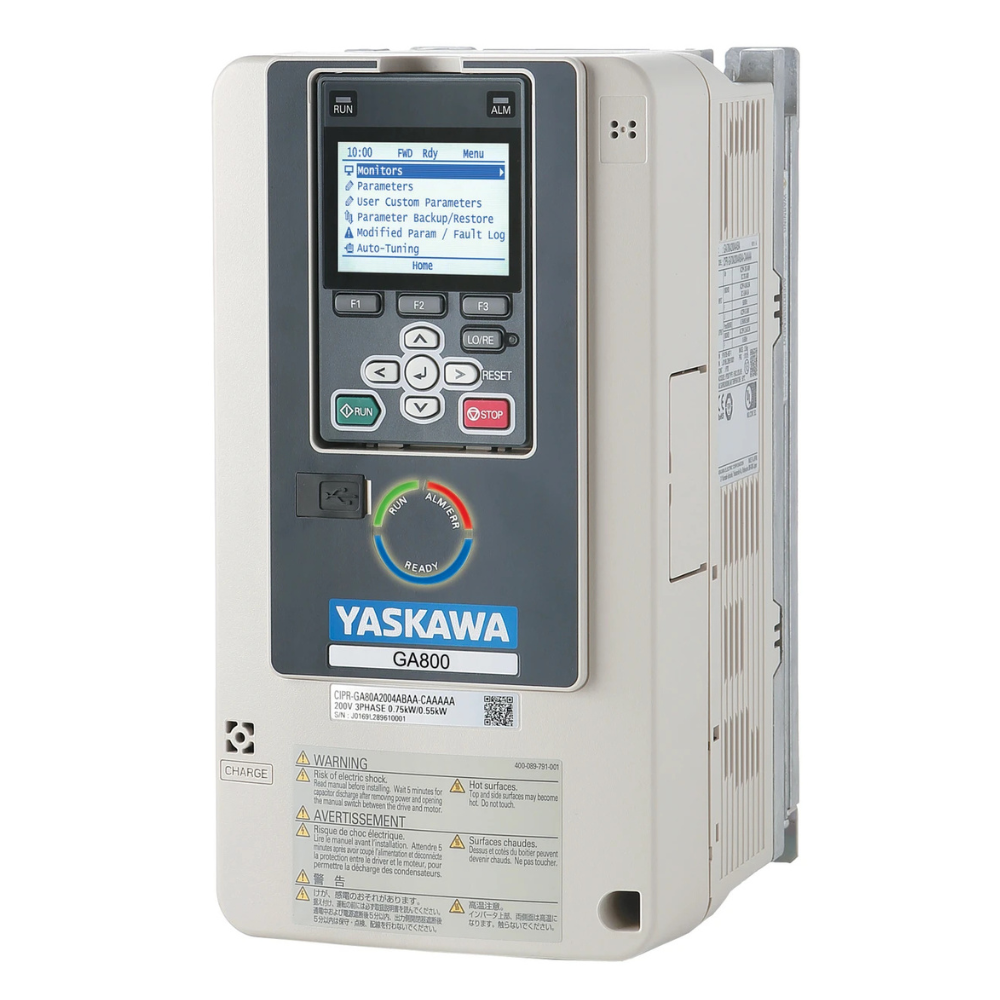
DC drive components are becomingincreasingly difficult to source as manufacturers phase out product lines anddistributors reduce inventory. When a critical DC component fails and the partisn't readily available, a short maintenance event can become a days-longshutdown. AC drive components — particularly from market-leading manufacturerslike Yaskawa — are widely stocked and available for rapid shipment.
Converting from DC to AC is nota simple drop-in replacement. Done incorrectly, it can create problems thatcost more than the conversion itself. The most common errors involve motorselection and enclosure design.
The replacement motor must be avector-rated AC motor with a constant blower — not a standard NEMA motor or aVFD-rated motor. The constant blower ensures adequate cooling at low speeds,where a motor-mounted fan would be insufficient. The motor must also be sizedcorrectly for the RPM requirement of the application — a 300HP/1150RPM DC motorcannot simply be replaced with a 300HP/1750RPM AC motor due to the significanttorque difference between them.
The enclosure must be designedfor the thermal output of an AC drive, which runs hotter than a DC drive.Installing an AC drive in an enclosure designed for DC without addressingcooling is a common mistake that leads to premature drive failure.
Given the number of variablesinvolved in a DC to AC conversion — motor selection, enclosure design, drivesizing, cooling, wiring, and compliance — the risk of getting something wrongis real, particularly for facilities without deep AC drive expertise.Pre-engineered conversion packages from suppliers who specialize in extrusionapplications eliminate most of that risk by packaging the right components in aproperly designed enclosure, with the application knowledge already built in.
For facilities that need to movequickly — particularly in emergency situations — pre-engineered systems thatare stocked and ready to ship in 24 hours are the difference between a briefinterruption and an extended shutdown.
In most cases, no. As long asyou are using a proper vector-rated drive and motor and you are notover-exciting the field of your DC motor to increase torque, a same-horsepowerAC system will deliver equivalent or better performance. AC vector motors havea much wider constant torque speed range than DC motors, which means theymaintain torque at low speeds without the oversizing that was sometimes used tocompensate for DC limitations. However, if your current DC system has beenfield-modified to produce more than rated torque, that needs to be accountedfor in the AC specification.
Probably not, and attempting todo so is one of the most common conversion mistakes. AC drives produce moreheat than DC drives, and an enclosure designed for DC cooling may be inadequatefor AC — particularly for systems above 100 horsepower. Before reusing anexisting enclosure, obtain the watt loss specification for the AC drive fromthe manufacturer and verify that the enclosure's cooling capacity issufficient. In most cases above 100HP, a new enclosure with proper thermaldesign is the right answer.
You need a vector-rated AC motorwith a constant blower — not a standard NEMA motor with a shaft-mounted coolingfan, and not a standard VFD-rated motor. The constant blower ensures adequatecooling across the full speed range, including low-speed extrusion conditionswhere a shaft-mounted fan would be turning too slowly to provide sufficientairflow. The motor should also be specified with an extruder duty rating thatincludes a shaft grounding ring and insulated bearing to mitigate bearingcurrents.
Emergency conversions almostalways cost more than planned ones — sometimes significantly more. Lead timefor large horsepower motors and enclosures can stretch days to weeks if systemsaren't in stock. Every day the line is down waiting for parts costs real money.Facilities that plan their DC to AC conversion proactively — rather thanwaiting for a failure to force the issue — consistently achieve better outcomesat lower total cost. Stocking a pre-engineered replacement system is an optionfor facilities that want failure protection without committing to an immediateinstallation.
For a planned conversion with apre-engineered system, installation typically takes one to two days dependingon the complexity of the line and the condition of the existing wiring.Emergency conversions with expedited parts can often be completed in a similartimeframe once the system arrives on site. The longest lead time element isusually the motor if it isn't in stock — which is why suppliers who stockmotors through 500HP provide a significant advantage in time-criticalsituations.