
Discover how advanced control systems improve product consistency, reduce waste, and optimize your extrusion process. Explore our solutions or connect with our team to learn how ICT can modernize your production line.
Get Started TodayCompounding — blending polymers with fillers, additives, reinforcements, and other materials to create a customized formulation — is one of the more demanding applications in extrusion, precisely because the control system isn't just managing a single, well-characterized material through a straightforward process. It's managing a formulation that may change from batch to batch, with materials that behave differently under heat and shear than the base polymer alone, and with quality requirements that are often tighter than standard extrusion applications. Understanding where control challenges specifically arise in compounding — rather than treating it as a variation on standard extrusion control — clarifies what capability actually matters for these lines.
Compounding introduces process variables and requirements that don't apply, or apply much less significantly, to single-material extrusion applications.
Unlike a line running the same base resin continuously, a compounding operation may run many different formulations over the course of a week or even a shift — different filler loadings, different additive packages, different base polymer blends — each of which may require different process settings to run correctly.
Many compounded formulations, particularly those with high filler loading or reinforcement content, are significantly more sensitive to torque and shear than unfilled polymers, meaning small variations in screw speed or temperature can have an outsized effect on material properties and processability.
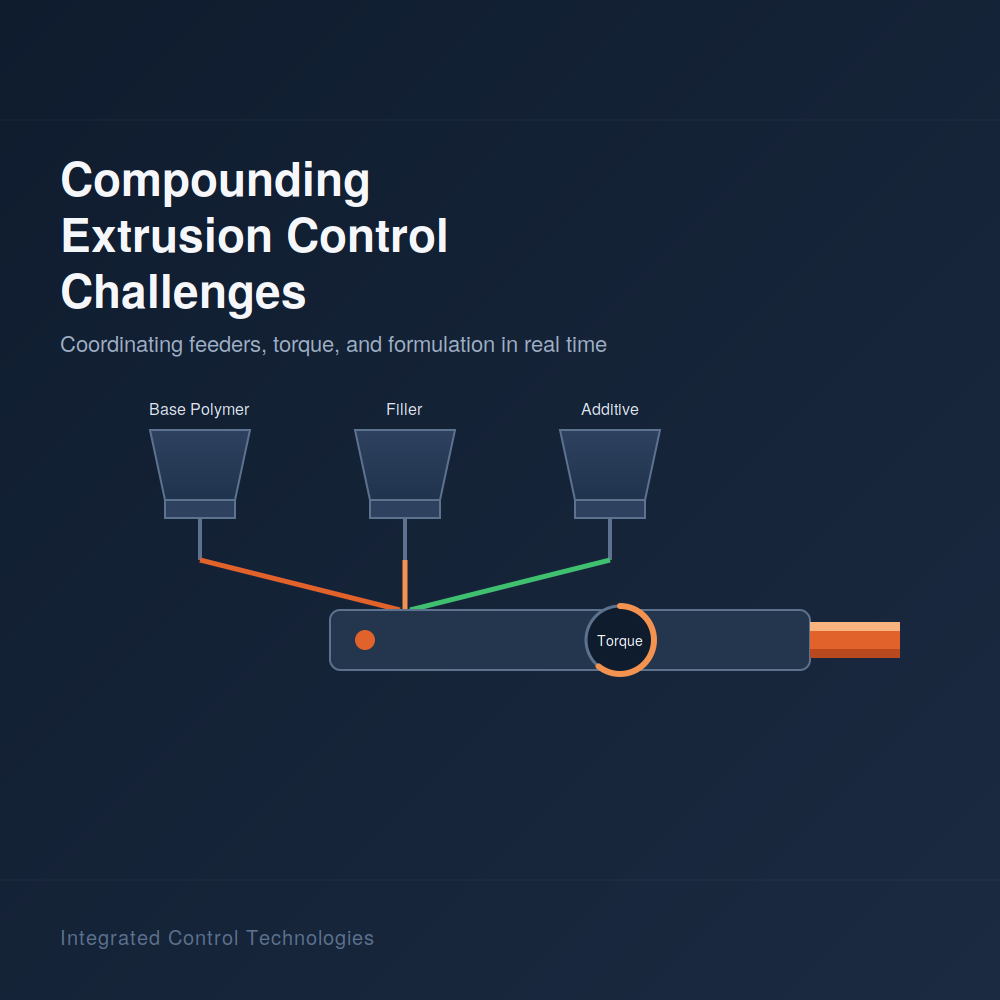
Compounding lines typically involve multiple feeders — for the base polymer, fillers, additives, and reinforcements — that need to maintain precise, coordinated feed ratios to hit the target formulation, which is a more complex control problem than managing a single material feed.
Many compounding formulations, particularly those involving heat-sensitive additives or reinforcements, require more precise temperature control than standard extrusion, since both under- and over-processing can degrade material properties or damage additives.
Several categories of control challenge show up specifically in compounding applications, more prominently than in simpler extrusion processes.
Maintaining accurate, coordinated feed rates across multiple gravimetric or volumetric feeders — keeping the ratio between base polymer, fillers, and additives consistent even as line speed changes — requires control logic specifically designed for multi-feeder coordination, which basic single-material extrusion controls often don't provide.
Highly filled or reinforced formulations can push extruder torque toward its mechanical limits, and control systems need to manage this dynamically — adjusting screw speed or feed rate in response to torque conditions — without simply shutting down or arbitrarily limiting throughput more than necessary.
With potentially dozens or hundreds of distinct formulations run over time, recipe management for compounding needs to handle a much larger and more complex library than a typical single-material extrusion line, including formulation-specific feeder setpoints, temperature profiles, and speed parameters.
Detecting whether a formulation is running correctly — particularly during changeover to a new formulation — requires monitoring capability that can flag deviations quickly, since compounding formulation errors can be more costly than standard extrusion errors, given the value of specialty additives and reinforcements involved.
Compounding lines depend on tight integration between feeder control systems (often from a different manufacturer than the extruder controls) and the extruder's own control system, which requires a communication architecture that basic extrusion control platforms aren't always designed to support well.
The gap between basic extrusion control and what compounding operations actually need is where a control system built with compounding-specific capability delivers real value.
Purpose-built compounding control architecture manages feeder coordination as an integrated part of the overall control logic, rather than treating feeders as a separate system loosely connected to the extruder controls, improving formulation accuracy and consistency.
More sophisticated control algorithms can manage screw speed and feed rate dynamically in response to real-time torque conditions, maximizing throughput within safe mechanical limits rather than relying on conservative fixed limits that leave capacity unused.
A control system designed for compounding's higher formulation volume typically includes more capable recipe management — searchable by product, customer, or formulation code — making it practical to manage a much larger recipe library than a basic system designed for a handful of standard products.
Modern systems can be configured to flag specific deviations relevant to a given formulation — for example, alerting if torque or melt temperature falls outside the range known to be acceptable for that specific formulation, rather than relying on generic process alarms that don't account for formulation-specific tolerances.
Because compounding requirements are more specialized than standard extrusion, evaluating control system needs for a compounding line benefits from a more deliberate assessment than a general extrusion control upgrade might require.
A compounding operation running a small number of stable formulations has different control requirements than one running frequent formulation changes across a large and evolving product line — understanding this pattern helps determine how much investment in recipe management and changeover efficiency is actually justified.
Before specifying a new control system, assess how well the existing feeders integrate — or would need to integrate — with the proposed extruder controls, since feeder-extruder communication architecture is a common source of underperformance in compounding line upgrades that don't account for it specifically.
Given how different compounding control requirements are from standard extrusion, vendor experience with compounding applications specifically — not just extrusion generally — is a meaningfully more relevant qualification to evaluate during vendor selection.
Compounding requires coordinating multiple feed streams, managing torque and shear sensitivity for filled or reinforced materials, and handling a much larger and more complex recipe library — capabilities that basic single-material extrusion controls often aren't designed to support well.
Highly filled or reinforced formulations can push extruder torque closer to its mechanical limits than unfilled polymers, requiring more dynamic and precise torque management to maintain throughput without exceeding safe operating limits.
Generally yes — compounding operations often run a much larger number of distinct formulations than typical extrusion applications, requiring a more robust and searchable recipe management system to handle that volume effectively.
Compounding-specific experience is a meaningfully relevant qualification, given how different the control challenges are from standard extrusion — a vendor without that specific experience may underestimate requirements like multi-feeder coordination and torque management.