Discover how advanced control systems improve product consistency, reduce waste, and optimize your extrusion process. Explore our solutions or connect with our team to learn how ICT can modernize your production line.
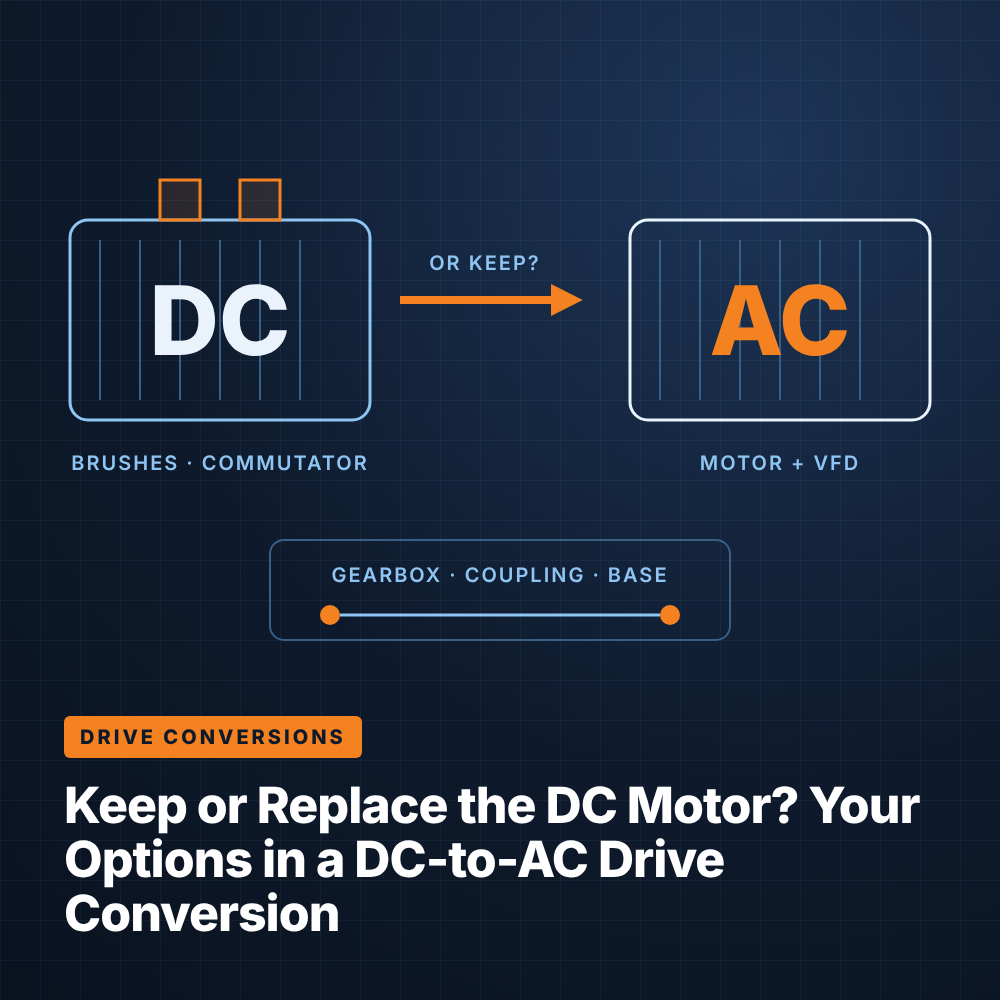
Get Started TodayWhen an extruder's DC drive reaches end of life, the first question is usually about the drive cabinet, but the bigger decision sits on the motor base. A plant can install a modern digital DC drive and keep the existing DC motor, or it can replace both with an AC motor and variable frequency drive (VFD). Both paths are legitimate, and the right one depends on the motor's condition, the mechanical installation, the process load, and how much downtime and long-term maintenance the plant is willing to carry.
Each option solves the immediate problem of an obsolete drive. They differ in what stays in service, what changes mechanically, and what the plant maintains afterward.
Current-generation digital DC drives offer far better diagnostics, communications, and tuning than the analog or early digital units they replace. They connect to the PLC over an industrial network, provide tighter speed regulation, and log faults in a way older drives cannot. The DC motor, its base, coupling, and gearbox stay in place, so the mechanical scope is minimal.
The trade-off is that the plant keeps a commutated machine. Brushes, commutator, and brush rigging still need inspection and periodic service, and the motor will eventually need a rebuild. A new drive does nothing to extend the life of a motor that is already near the end of its usable service.
An AC induction motor paired with a vector-control VFD eliminates brushes and commutators entirely. Routine maintenance drops largely to bearings and cooling, and AC motors and drives are widely available from multiple manufacturers. The industry shift toward AC on extruders is covered in more detail in why the industry has already made the switch to AC.
The trade-off is mechanical scope. A new motor may not match the existing frame, shaft, or mounting, and adapting it to the gearbox takes engineering and installation time that a drive-only swap avoids.
The existing motor's health often decides the question before anything else is considered. A motor in good shape makes Option A credible, while a tired motor tilts the decision strongly toward AC.
Every DC motor rebuild involves work on the armature, commutator, and often the field windings. Each cycle can reduce margin in insulation, commutator thickness, and winding integrity, and the motor may run hotter or less efficiently after several rebuilds. The cumulative impact is discussed in the effects of multiple rebuilds on DC motor life and efficiency.
Before committing to a new DC drive, it is worth reviewing the motor's service records and running insulation resistance and polarization index tests. A motor with a clean record and healthy test results can serve for years on a new drive. One with repeated rebuilds or declining insulation is a weak foundation for a new investment.
Brush wear rates, commutator condition, and sparking under load reveal how well the motor is coping with its duty. Heavy, uneven wear or frequent flashover events suggest the motor is struggling, and a new drive with better current control may help but will not fix underlying mechanical or winding problems.
Bearing condition, vibration trends, and armature temperature under normal load round out the picture. Plants that already collect this data through a predictive maintenance program are well positioned to make an informed call, while plants without it should gather a baseline before the drive decision is finalized.
If the motor is healthy, the decision shifts to how easily an AC motor fits the installation and whether it can handle the process load. These factors determine the real scope of an AC conversion.
DC and AC motors of similar power often use different frame sizes, shaft heights, and shaft dimensions. A replacement AC motor may need an adapter base, a new coupling, or a C-face or flange adapter to mate with the gearbox. In some installations the swap is straightforward; in others, alignment, shaft height, and guarding all need rework. A site survey with accurate dimensions of the motor, base, and gearbox input should come before any motor is ordered.
Extruders are constant-torque loads, and they need full torque at low speed during startup with cold or partially melted material in the barrel. DC motors deliver this naturally. A properly sized AC motor on a closed-loop vector drive also delivers rated torque down to very low speeds, but the motor must be selected for constant-torque duty over the full speed range, and the drive must be sized for the starting and overload demands of the screw. Matching the AC motor's base speed to the existing gearbox ratio is part of that sizing.
Many extruder DC motors use a separately powered blower so they can run cool at low speed. AC motors driven at low speed on a VFD face the same issue, since a shaft-mounted fan moves less air as speed drops. Inverter-duty AC motors with a constant-speed auxiliary blower, or totally enclosed designs rated for the speed range, address this. The cooling arrangement, filtration, and airflow path should be specified as part of the motor selection, not treated as an afterthought.
Older DC systems often used a tachometer generator for speed feedback. A new DC drive can use the existing tach or an encoder, while closed-loop AC vector control typically requires an encoder on the motor. Encoder mounting, cable routing, and noise immunity all affect speed regulation, so the feedback device and its installation deserve the same attention as the motor itself.
The final considerations are practical: how long the line can be down, what the plant will stock afterward, and how the choice fits the broader controls strategy.
A DC drive replacement that reuses the motor and much of the field wiring is usually the shorter outage. An AC conversion adds motor removal, base or adapter work, alignment, and new power and feedback cabling. Much of this can be prepared in advance with a pre-built drive cabinet, pre-fabricated adapters, and a detailed cutover plan, which keeps the shutdown focused on installation and commissioning rather than fabrication.
Spares strategy is a long-term cost that is easy to overlook. A plant keeping DC motors must stock brushes and maintain access to rebuild shops with DC experience. AC motors and drives are broadly available, which can simplify spare inventory, especially if several lines standardize on the same drive family. Plants with a mix of DC and AC equipment should weigh whether a single standard reduces training and stocking burden.
Weighing these factors together usually points clearly to one path:
Integrated Control Technologies helps plants assess motor condition, mechanical fit, and control integration before choosing. Its DC-to-AC conversion work covers motor selection, engineered drive cabinets, and PLC integration for extruders.
Yes, modern digital DC drives are designed to run existing DC motors and can use the existing tach or a new encoder. The motor should be tested first, since a new drive will not extend the life of a motor with weak insulation or a worn commutator. A healthy motor can continue in service for years.
A correctly sized AC motor on a closed-loop vector drive produces rated torque down to very low speed. The motor must be selected for constant-torque duty, and the drive must be sized for startup and overload demands. Proper sizing against the gearbox ratio is essential.
Usually not. Most conversions keep the existing gearbox and use an adapter base, flange, or new coupling to mate the AC motor. A site survey confirms frame, shaft, and mounting dimensions before the motor is ordered.
A drive-only DC replacement is typically shorter because the motor and much of the wiring stay in place. An AC conversion involves more mechanical work, but pre-built cabinets and adapters prepared in advance can keep the shutdown manageable.