Discover how advanced control systems improve product consistency, reduce waste, and optimize your extrusion process. Explore our solutions or connect with our team to learn how ICT can modernize your production line.
Get Started TodayMost extruder barrel zones run on PID loops that were tuned once, often by pressing an autotune button during commissioning, and never touched again. Autotune is a useful tool, but the conditions under which it runs rarely match the conditions under which the zone actually has to perform. Barrel zones are asymmetric, coupled to their neighbors and heavily influenced by the process itself. Understanding where autotune falls short helps process and controls engineers get tighter melt temperature control and fewer alarms without guesswork.
A barrel zone is not a simple oven. It has two actuators that behave very differently, a large thermal mass and a heat source that the controller does not command at all.
Most zones use resistance band heaters for heating and either blowers or water for cooling. A heater delivers energy roughly in proportion to its duty cycle, and the response is fairly predictable. Cooling is different: its effectiveness depends on the temperature difference between the barrel and the cooling medium, the airflow or water flow, and the condition of the fins or jacket. The result is a process gain on the cooling side that can be much higher or much lower than on the heating side, and it changes with operating point.
A single set of PID gains applied to both directions will usually be right for one and wrong for the other. That is why most modern temperature controllers and PLC-based temperature function blocks offer a separate cooling gain or a separate cooling output tuning, and why using it matters.
Heat must travel from the heater band through the barrel wall to the thermocouple tip and on to the melt. That path creates dead time and a long lag. Loops with significant dead time punish aggressive integral and derivative action, so gains that look acceptable on paper can oscillate slowly on a real barrel. The slower the zone, the more important it is that the tune reflects the zone's actual time constants rather than a generic default.
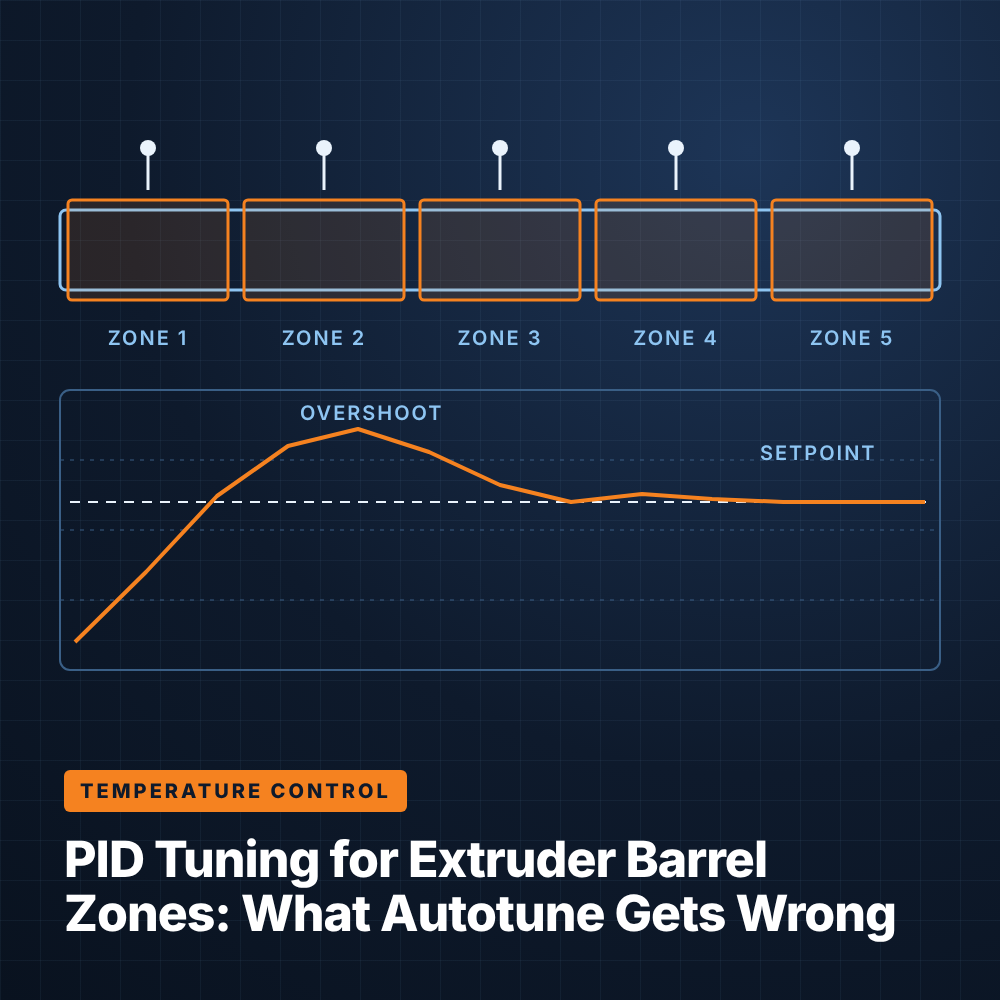
Adjacent zones share steel. Heat flows along the barrel from a hot zone into a cooler neighbor, and a zone that is cooling hard will pull heat from the zones on either side. When each zone is tuned in isolation, the interaction can produce a slow seesaw in which two neighbors take turns heating and cooling against each other. The fix is usually not more aggressive tuning but less: softer integral action on the zones most affected and setpoint profiles that avoid steep temperature steps between adjacent zones.
Autotune routines apply a step or a relay oscillation, watch the response and calculate gains from the observed process gain, lag and dead time. The problem is the operating point at which the measurement is taken.
Autotune is commonly run during startup or on an empty barrel, when the screw is stationary and no material is flowing. Under those conditions, the only heat load is losses to the surroundings. Once the line is running, polymer is carrying heat away in some zones and adding it through shear in others. The process gain and the effective time constant can shift substantially, so gains derived from an idle barrel are often too aggressive in some zones and too sluggish in others.
As screw speed increases, mechanical energy from the drive turns into heat in the melt. In the metering and transition zones, shear heating can supply most or all of the energy needed to hold setpoint, leaving the heaters idle and the zone dependent almost entirely on cooling. A zone tuned as a heating loop at low speed becomes, in practice, a cooling loop at production speed. Autotune performed at zero or low screw speed never sees this regime.
Autotune often optimizes for fast response, which is welcome on a cold startup but leads to overshoot on setpoint changes and disturbances. On a barrel, overshoot is not just cosmetic. It can degrade heat-sensitive materials, trigger high-temperature alarms and force the cooling output on, which then drives the zone below setpoint and starts the cycle again. A deliberately slower, well-damped tune usually produces more consistent melt temperature than a fast one that rings.
Good barrel zone tuning starts with hardware and configuration, not gains. Several details have more effect on control quality than the PID numbers themselves.
Air cooling is relatively gentle and roughly proportional, so it tolerates time-proportioned output well. Water cooling is far more aggressive, and its effect is strongly nonlinear: a short pulse of water at a hot barrel can flash to steam and remove a large amount of heat at once. Water-cooled zones generally need a much lower cooling gain, shorter minimum pulse widths and sometimes a nonlinear cooling curve that is built into many temperature controllers. Treating water cooling like air is a common source of zones that oscillate around setpoint.
Where the thermocouple sits determines what the loop controls. A shallow thermocouple near the heater band responds quickly but reports heater temperature more than barrel or melt temperature. A deep well thermocouple close to the bore reflects process conditions better but adds lag. The tune must match the sensor. Loose or poorly seated thermocouples, mismatched thermocouple types and damaged extension wire all add noise or offset that no tuning can correct.
A deadband or overlap setting determines how far the output must move before cooling engages after heating stops. Too little deadband lets the zone chatter between heating and cooling, wasting energy and wearing contactors or solenoid valves. Too much leaves a band in which the zone drifts uncontrolled. The right value depends on how strong the cooling is relative to heating, and it should be revisited whenever the cooling method or heater capacity changes.
A tune is valid for the process it was derived from. When that process changes enough, the tune should change with it.
Changes in screw design, a new resin family, significantly different line rates, replaced heater bands, a switch from air to water cooling or relocated thermocouples all alter zone dynamics. Persistent symptoms are also a trigger: zones that cycle between heating and cooling, slow oscillations visible on trends, frequent deviation alarms or a zone running at full cooling output for long periods.
The most reliable approach is to use autotune, if desired, for an initial set of heating gains and then refine at normal production speed with material flowing. Small, manual setpoint steps of a few degrees while running reveal how the zone actually behaves under shear and flow. Some plants maintain separate parameter sets for startup and production, switched automatically when the screw reaches a speed threshold.
Tuning decisions are only as good as the data behind them. Trending setpoint, process value, heating output and cooling output together on the same time scale makes asymmetry and zone interaction obvious.
If zones need constant attention, the limitation may be the control platform rather than the tune. Older standalone controllers often lack separate cooling parameters, nonlinear water cooling curves, gain scheduling or any meaningful trending.
A modern extruder control system should support independent heat and cool tuning per zone, configurable deadband and cycle times, parameter sets that can follow recipes or operating states, and historical trends accessible from the HMI. Centralizing barrel temperature control in the PLC also makes it possible to coordinate zones and log tuning changes, which supports the broader goals discussed in temperature control and consistency in extrusion.
When planning a controls upgrade, it is worth auditing thermocouples, heater bands, cooling hardware and wiring at the same time, since even an excellent control platform cannot tune around failing field devices. ICT's extruder control systems bring barrel temperature control, drive control and data visibility onto a single platform, giving engineers the tools to tune zones for the way the line actually runs.
Autotune provides a reasonable starting point, especially for heating gains on zones with little shear heating. It rarely produces an optimal cooling tune or accounts for production conditions. Treat it as a first pass and refine with the line running.
The most common causes are too little deadband, an overly aggressive cooling gain or interaction with an adjacent zone. Shear heating that pushes the zone above setpoint can also force constant cooling. Trending both outputs alongside temperature usually identifies which cause applies.
Yes. Water cooling is much stronger and highly nonlinear, so it needs lower cooling gain, short pulse widths and often a nonlinear cooling characteristic. Using air-cooling parameters on a water-cooled zone is a frequent cause of oscillation.
There is no fixed interval. Retune when the process changes materially, such as a new screw, a different material, new heaters or a change in cooling method, or when trends show persistent oscillation or saturated outputs. Stable lines may run for years on a sound tune.