
Discover how advanced control systems improve product consistency, reduce waste, and optimize your extrusion process. Explore our solutions or connect with our team to learn how ICT can modernize your production line.
Get Started TodayOne of the most common questions plant managers ask before committing to a control system upgrade isn't about features or specifications — it's simply, "how long will my line be down?" It's a fair question, because production schedules, customer commitments, and staffing plans all revolve around that number. Yet it's also one of the hardest questions to answer with a single figure, because installation timelines depend heavily on scope, existing infrastructure, and how much of the work can happen before the line actually stops running.
Understanding the real phases of an installation — and which parts can happen off-line versus which parts require the extruder to be down — makes it possible to plan around the disruption instead of just absorbing it.
A well-run control upgrade isn't a single event — it's a sequence of distinct phases, several of which can happen without touching the production schedule at all.
This phase happens entirely off the plant floor and doesn't affect production. It includes finalizing the control architecture, programming the PLC logic, designing HMI screens, and building or configuring the drive cabinets. For pre-engineered platforms, much of this work is already done and simply needs to be adapted to the specific line; for custom systems, this phase takes considerably longer.
Also happening off-line, this is when the physical control panel — drives, PLC hardware, wiring, terminal blocks — is assembled and tested at the vendor's facility or a staging area, rather than on the plant floor. Staging and pre-testing the panel before it ever reaches the plant significantly reduces the on-site installation time, since many issues that would otherwise surface during commissioning get caught and fixed beforehand.
This is the phase that actually requires production downtime: removing the old control panel and wiring, installing the new panel, connecting drives to motors, wiring sensors and field devices, and running conduit or cable as needed. The duration here depends heavily on how much of the existing wiring and infrastructure can be reused versus rebuilt.
Once physically installed, the system needs to be commissioned — verifying I/O, tuning drive parameters, testing safety interlocks, and running the line through its actual process to confirm temperature control, speed regulation, and process behavior all match expectations. This phase also requires the line to be down, though toward the end of it the line may be running intermittently as adjustments are made.
Even after the system is technically commissioned, there's typically a ramp-up period where operators are getting familiar with the new HMI and the process may run somewhat below full rate while everyone adjusts. This period doesn't require the line to be fully down, but throughput may be temporarily lower than the pre-upgrade baseline.
The headline number plants care about — total line-down time — is shaped by a handful of specific factors.
If field wiring to sensors, motors, and downstream equipment is in good condition and well-documented, it can often be reconnected to the new panel rather than rebuilt from scratch, which significantly shortens on-site installation time. Poorly documented or degraded wiring adds time, since it typically needs to be traced and verified before reconnection.
Pre-engineered, standardized control platforms are designed with installation speed in mind — consistent wire numbering, proven panel layouts, and commissioning procedures that have been refined across many prior installations. Custom-engineered systems, while sometimes necessary, typically take longer to commission because the process is being worked out for the first time rather than repeated from a known template.
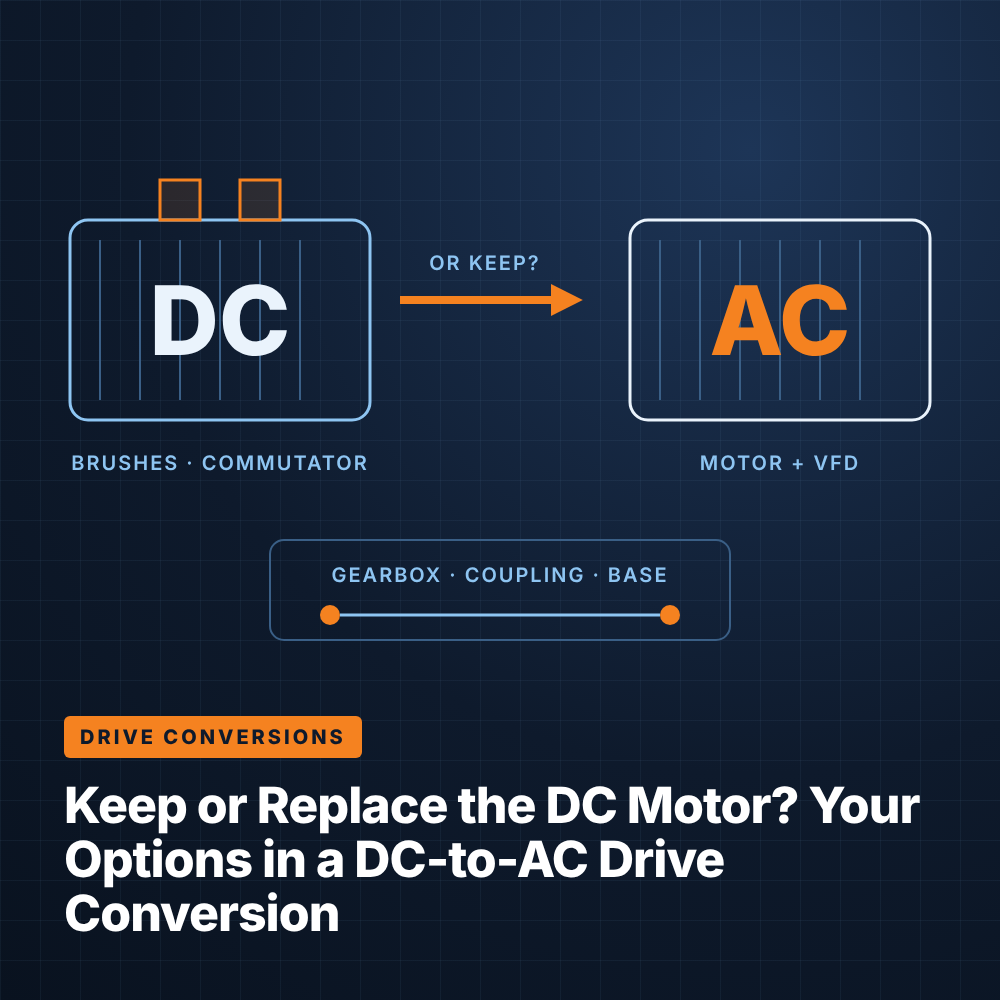
If the project includes converting from DC to AC drives, the downtime window typically extends, since this often requires motor changes or rework in addition to the drive and control panel replacement — more physical work translates directly into more on-site time.
Installations move fastest when the process requirements — temperature profiles, speed ranges, alarm setpoints, safety interlocks — are fully defined and agreed upon before installation begins. Discovering process requirements during commissioning, rather than during the design phase, is one of the most common causes of installation delays.
Because downtime during Phases 3 and 4 is largely unavoidable, the more productive question for most plants is how to plan the surrounding production schedule to absorb it with minimal disruption.
Where possible, aligning the installation with an already-planned maintenance shutdown or a naturally slower production period reduces the marginal cost of the downtime, since some of that time was already going to be non-productive.
For lines feeding time-sensitive customer commitments, building a modest inventory buffer in the weeks leading up to the installation can absorb the downtime window without affecting delivery schedules.
Plants with multiple lines running the same or similar products have more flexibility to shift production to other lines temporarily. Sequencing which line goes first, and confirming the remaining lines have the capacity to cover the gap, is worth planning explicitly rather than assuming it will work out.
It's worth asking vendors for both a best-case and a realistic-case timeline, and planning the production schedule around the realistic one. Installation delays are common enough — due to unexpected wiring conditions or process adjustments during commissioning — that padding the internal schedule protects against overpromising to customers.
For plants planning multiple line upgrades over time, each installation is an opportunity to standardize documentation and wiring practices that make the next one faster — consistent wire numbering, updated as-built drawings, and centralized process specifications all compound to reduce downtime on subsequent projects.
It varies significantly based on line complexity and scope, but a well-staged, pre-engineered installation on a line with good existing wiring documentation is generally faster than a custom system requiring extensive rewiring — asking for a scope-specific estimate rather than a general average is the more reliable approach.
Yes — design, engineering, and panel build/staging all happen off the production floor and don't require the line to be down. Only physical installation and commissioning require downtime.
Generally, yes, since DC-to-AC conversions often involve motor changes or rework in addition to the control panel and drive replacement, adding to the on-site installation scope.
Having a fully defined process specification — temperature profiles, speed ranges, safety interlocks — agreed upon before installation begins is one of the most reliable ways to avoid delays that occur when requirements are worked out during commissioning instead.