
Discover how advanced control systems improve product consistency, reduce waste, and optimize your extrusion process. Explore our solutions or connect with our team to learn how ICT can modernize your production line.
Get Started TodayFor most manufacturers running plastics extrusion lines, the decision to upgrade an aging control system isn't really a question of "if" — it's a question of "when," and more pressingly, "how much." Legacy DC drives and outdated PLC platforms don't fail all at once. They degrade slowly, through more frequent nuisance faults, longer troubleshooting sessions, and parts that get harder to find every year. By the time a plant manager brings a control upgrade to the capital budget, the conversation is usually less about whether to do it and more about how to size the investment correctly.
The problem is that extruder control upgrades don't have a single, predictable price tag. A wire drawdown line and a multilayer blown film line have completely different control architectures, I/O counts, and integration requirements. Understanding what actually drives the cost of an upgrade — rather than relying on a rough per-line average — is what separates a budget that holds up from one that blows past approval halfway through the project.
Ask five different vendors for a ballpark number on a control retrofit and you'll likely get five different answers, sometimes off by a factor of two or three. That's not vendors being cagey — it reflects how many variables actually go into pricing a system.
The single biggest driver of cost is how many independently controlled zones the line has. A single-screw extruder with four or five heat zones is a fundamentally simpler control problem than a co-extrusion blown film line with multiple extruders, each with its own temperature profile, screw speed control, and layer ratio management. More zones mean more I/O points, more drives, more wiring, and more programming hours — all of which scale the price.
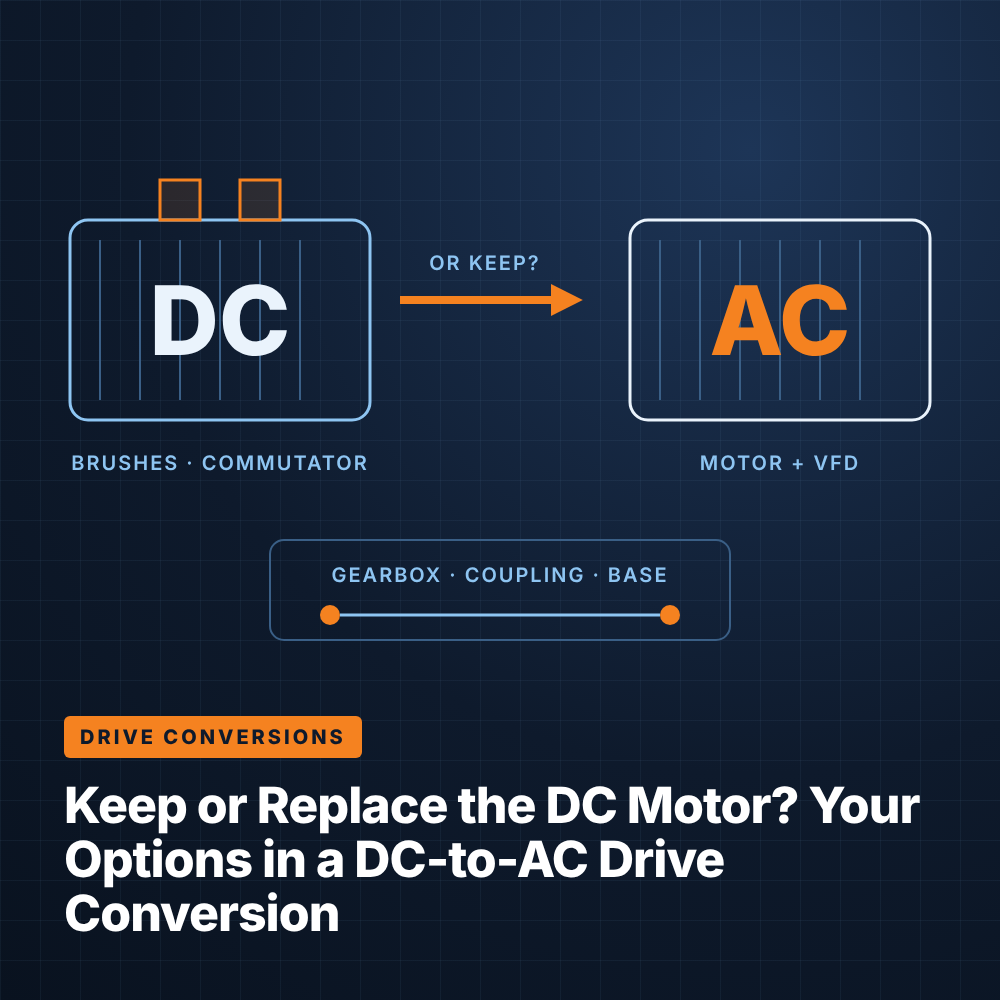
Whether the upgrade includes a full DC-to-AC drive conversion or simply replaces an existing AC drive package matters enormously. DC-to-AC conversions typically require new motors or motor rework, different wiring topology, and sometimes structural changes to the drive cabinet. If drives need to be significantly upsized to support future line speed increases, that adds cost on both the equipment and installation side.
Standardized, pre-engineered control platforms cost less than fully custom-engineered systems, for the simple reason that engineering hours are a major cost component. A line with unusual process requirements — non-standard extrusion applications, specialized downstream integration, or unique safety interlocks — will require more design time than a line that fits a proven, repeatable architecture.
Few upgrades happen on a blank slate. Most projects need to interface new controls with existing gear pumps, dies, cooling systems, winders, or downstream equipment that isn't being replaced. The condition and documentation quality of that existing equipment has a direct impact on integration cost — a well-documented line is far cheaper to integrate with than one with decades of undocumented modifications.
Plant teams building an internal budget for a control upgrade often anchor on the visible, big-ticket items — drives, PLC hardware, the operator interface — and underestimate everything around them.
Hardware is often the smaller half of the cost equation. Control logic programming, HMI screen design, commissioning support, and documentation can represent a substantial share of total project cost, particularly for lines with custom process requirements.
This is the cost most frequently left out of internal budgets entirely, yet it's often the largest true cost of the project. Every day a line is down for the upgrade is a day of lost production. Budgets should account for the value of that downtime, not just the invoice from the controls vendor — and should factor in whether a pre-engineered system (with faster commissioning) meaningfully reduces that window compared to a fully custom build.
A new control platform often means retiring the spare parts inventory built up for the old system and starting a new one. Budgets should include an initial spares stock for the new drives, PLC modules, and HMI hardware, plus operator and maintenance training so the plant floor isn't relearning the system through trial and error during a production run.
Older facilities sometimes discover, mid-project, that supporting infrastructure — panel space, incoming power capacity, grounding, or cable pathways — needs upgrading to accommodate new drive technology. This is difficult to predict without an on-site assessment, which is exactly why skipping that assessment to save time upfront often costs more later.
Rather than chasing a single number, most plants are better served by building a range based on project scope, then narrowing it through a formal quote process.
Before requesting quotes, define the scope as precisely as possible: which lines, how many zones, what's being replaced versus retained, and what the desired outcome is (reliability, speed increase, better diagnostics, and so on). Vague scope requests produce vague — and often wildly inconsistent — quotes.
An itemized quote separating hardware, engineering, installation, and commissioning makes it far easier to compare vendors on an apples-to-apples basis and to identify where one vendor's approach differs from another's.
Even well-scoped projects encounter surprises once a cabinet is opened or wiring is traced. A contingency in the 10–15% range is standard practice for control upgrade projects and should be built into the internal budget from the start, not treated as a sign the project went over.
Pre-engineered, standardized control platforms — built around a proven architecture that's applied across many lines — generally cost less and commission faster than one-off custom designs, because the engineering cost is amortized across many installations rather than borne entirely by a single project. For lines that fit a common process type, this can meaningfully shrink both the budget and the schedule. Lines with genuinely unusual requirements may still need custom engineering, but it's worth confirming that assumption before assuming the more expensive path is the only option.
Getting a control upgrade approved often means translating engineering justification into financial terms that resonate with plant leadership and finance.
Rather than presenting the upgrade purely as a capital expense, frame it against the cost of unplanned downtime from a failing legacy system — including the risk of a drive failure that halts a line for days while an obsolete part is sourced. That comparison is often the most persuasive point in the proposal.
Where new controls offer real-time monitoring, more precise temperature regulation, or better process consistency, quantify the expected reduction in scrap or off-spec product. Even modest yield improvements compound significantly over a year of production.
If the full scope can't be approved at once, present a phased upgrade path — starting with the highest-risk or highest-impact line — so the project can begin without requiring the entire capital outlay upfront.
Costs vary significantly based on line complexity, zone count, and whether the project includes a DC-to-AC drive conversion. A simple single-screw retrofit will cost far less than a multilayer co-extrusion line upgrade, which is why a formal scope-based quote is more useful than a generic estimate.
Production downtime during installation and commissioning is the cost most often underestimated. It doesn't appear on a vendor invoice, but it's frequently the largest true cost of the project.
Generally, yes. Pre-engineered platforms spread engineering costs across many installations, which typically lowers both price and commissioning time compared to a fully custom-designed system, assuming the line fits a standard process type.
Phasing the upgrade — starting with the highest-risk or highest-downtime line — is a common approach that spreads capital expense over time while addressing the most urgent reliability concerns first.