Discover how advanced control systems improve product consistency, reduce waste, and optimize your extrusion process. Explore our solutions or connect with our team to learn how ICT can modernize your production line.
Get Started TodayThe pelletizer is the last step in a compounding or recycling line, and it is where upstream instability becomes visible as off-spec product. Strand breaks, fines, long cuts, and doubles are rarely random; they usually trace back to a mismatch between throughput and cutter speed, poorly controlled water temperature, or a startup that did not follow a consistent sequence. Because pellet geometry affects downstream feeding, drying, and customer acceptance, these defects carry real cost. This article covers the control mechanisms that keep pelletizing stable across both strand and underwater systems.
Both methods convert a molten polymer stream into uniform pellets, but they do it in fundamentally different ways. The control priorities follow from where and when the polymer is cut.
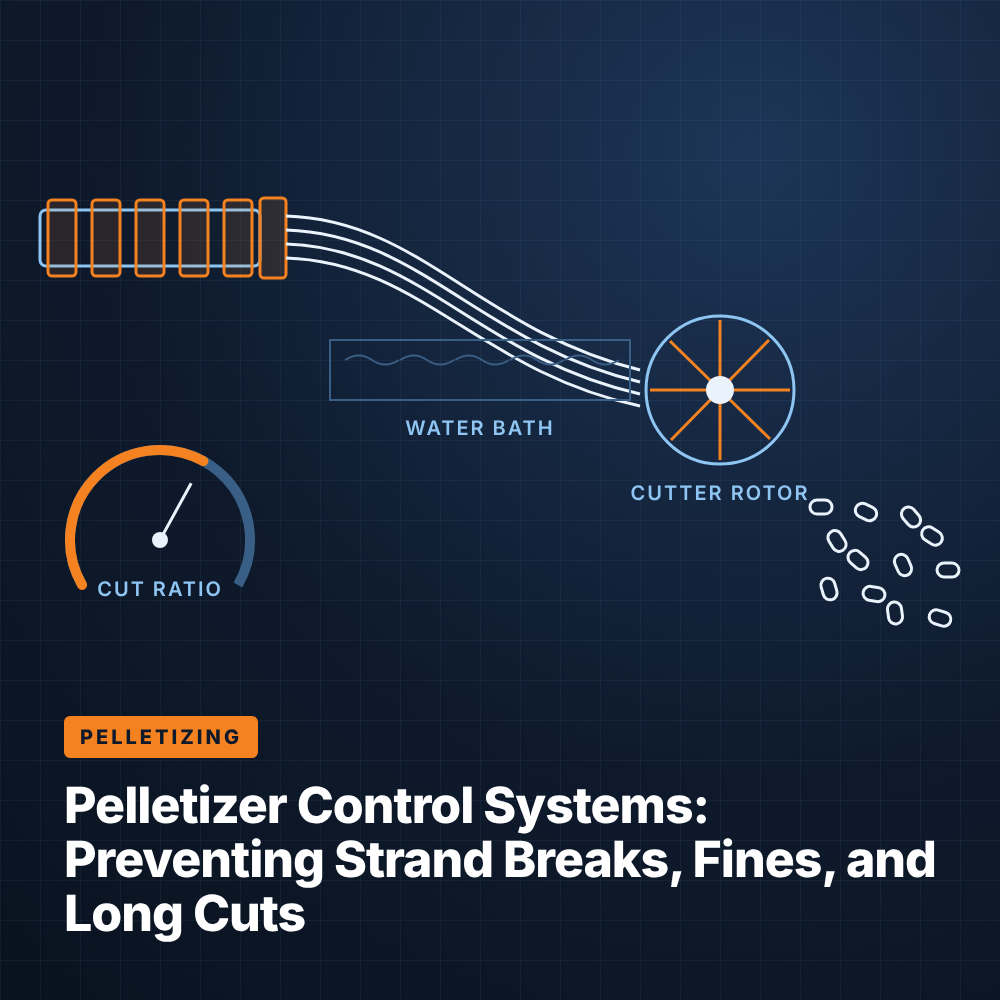
In a strand system, polymer exits a die as continuous strands, travels through a water bath to solidify, passes an air knife or dewatering section, and is drawn into a cutter by feed rolls. The strands are cut cold, after solidification. That makes strand tension, bath temperature, and the speed relationship between die output and the pelletizer feed rolls the key variables. If the strands are pulled too hard they neck down and break, and if they arrive too warm they smear or stick rather than cutting cleanly.
Underwater systems cut the melt directly at the die face inside a water-filled chamber. Rotating knives slice the polymer as it emerges, and process water immediately quenches the pellets and carries them to a dryer. Because cutting happens while the polymer is still molten, the die plate temperature, the water temperature, the knife speed, and the knife-to-die contact all interact in real time. The margin for error is narrower and the startup sequence is far more critical.
Strand lines are generally more forgiving and easier to troubleshoot visually, while underwater lines offer higher throughput, enclosed operation, and more uniform pellets at the cost of tighter control requirements. In both cases, the control system's job is the same: keep the cut synchronized with the flow of material and keep the polymer at the right temperature when the knife meets it.
Pellet length is set by the relationship between how fast material arrives at the cutter and how often the knives pass through it. Holding that relationship constant is the single most important control function on any pelletizer.
On a strand line, pellet length depends on feed roll speed relative to cutter rotor speed. On an underwater line, it depends on melt flow per die hole relative to knife passing frequency, which is knife hub speed multiplied by the number of blades. When the extruder or melt pump changes rate, the cutter speed must change proportionally to keep pellet size constant. A PLC-based ratio scheme ties the cutter drive reference to the extruder or gear pump speed so the two move together automatically.
Long cuts appear when material arrives faster than the knives can section it, often after an operator raises throughput without adjusting the cutter. Fines and dust come from the opposite condition, as well as from brittle strands that shatter during cutting, dull knives that tear rather than shear, or strands that are too cold for the polymer being run. Sudden pressure surges upstream can produce bursts of long cuts even when average ratios are correct, which is why melt pressure stability matters here as much as it does on any shaping line.
On strand pelletizers, the feed rolls effectively act as the puller for the entire strand path. If they run faster than the die output supports, strands stretch and break. If they run slower, strands slacken, wander in the bath, and can tangle or feed unevenly. Encoder feedback on the feed roll drive and a stable ratio to the extruder give consistent tension through the bath.
Water does the cooling in both pelletizing methods, and its temperature determines whether the polymer cuts cleanly. Small drifts can change pellet quality significantly over a shift.
Bath water that runs too cold makes strands brittle, increasing fines and breaks at the cutter. Water that runs too warm leaves strands soft, which causes smearing, tails, and pellets that stick together. A temperature control loop with a heat exchanger or tempered water supply, rather than relying on plant water whose temperature varies seasonally, holds the strand at a consistent temperature when it reaches the knives.
In underwater pelletizing, process water temperature affects both pellet shape and the thermal load on the die plate. Water that is too cold pulls heat from the die face and encourages freeze-off. Water that is too warm leads to agglomerates and poorly formed pellets. The process water system typically includes a heat exchanger with a PID-controlled valve, and the setpoint is often material specific and stored as part of the recipe.
Flow rate matters as much as temperature. Insufficient flow allows pellets to agglomerate in the cutting chamber or transport line, while excessive flow can disturb the cutting process. Flow meters or flow switches tied into the control system confirm adequate circulation before cutting is permitted and alarm if flow drops during operation.
Startup is the highest-risk moment on an underwater pelletizer. The sequence of events at the die face over a few seconds determines whether the line starts cleanly or requires a teardown.
Die plate freeze-off occurs when polymer solidifies in the die holes before or during startup. Process water contacting the die before melt is flowing, die heaters that have not reached setpoint, or a slow transition from diverter to the cutting chamber all allow the holes to cool. Once a portion of the holes freezes, the remaining holes carry more flow, producing irregular pellets and further imbalance.
A well-designed control sequence confirms die plate temperature, starts melt flow through the diverter valve to purge degraded material, then closes the cutting chamber, engages the knives, and floods the chamber with process water in a tightly timed order. Executing these steps automatically, with each permissive confirmed before the next action, removes the operator-to-operator variability that causes most freeze-off events. Shutdown benefits from the same treatment, ensuring water is drained and the die is cleared rather than left to freeze.
Strand lines are less sensitive but still benefit from structure. Ramping extruder and feed roll speeds together, confirming bath temperature, and verifying that the cutter is running before strands are threaded reduces the scrap and breaks common during manual startups.
Even with good ratio and temperature control, mechanical wear and missing safety logic can undermine pellet quality and endanger operators. This is also where most legacy pelletizer controls fall short.
Dull knives tear polymer instead of shearing it, generating fines, tails, and uneven pellets. On underwater pelletizers, knife-to-die contact is maintained by pneumatic, hydraulic, or mechanical advance, and excessive pressure accelerates wear on both the blades and the die face. Trending cutter motor current and logging knife hours give maintenance a data-driven basis for blade changes rather than waiting for pellet quality to deteriorate.
A pelletizer combines rotating knives, hot melt under pressure, and process water, so interlocks are essential for both safety and equipment protection. A typical set includes:
Older systems may implement some of these with hardwired relays and others not at all, which makes troubleshooting slow and leaves gaps in protection.
Lines with independent cutter and extruder speed settings, manual water temperature adjustment, or startup procedures that depend on operator experience are good candidates for modernization. Integrating the pelletizer into the main line PLC, with ratio control, automated sequencing, and recipe-based setpoints, addresses most recurring pellet defects. ICT's approach to that integration is described on the pelletizer control systems page.
Long cuts usually occur when material arrives at the cutter faster than the knives can section it. Common causes include throughput increases without a matching cutter speed change, upstream pressure surges, and strand breaks that allow multiple strands to feed unevenly.
Freeze-off happens when polymer solidifies in the die holes, typically because process water reached the die before melt was flowing or the die was below temperature. Automated startup sequencing with temperature and flow permissives is the most effective prevention.
Water that is too cold makes polymer brittle and causes fines, while water that is too warm leads to smearing, tails, and agglomerated pellets. Closed-loop temperature control keeps the polymer in the right state when it is cut.
Yes, in most cases the pelletizer drive, water system, and diverter valve can be brought under the same PLC as the extruder. That integration enables ratio control, coordinated startups, and interlocks across the whole line.