Discover how advanced control systems improve product consistency, reduce waste, and optimize your extrusion process. Explore our solutions or connect with our team to learn how ICT can modernize your production line.
Get Started TodayAsk any extrusion plant manager about their biggest quality headache, and batch-to-batch variation is almost always near the top of the list. Two runs of the same product, made on the same line, with the same nominal settings, can come out subtly different — different wall thickness, different surface finish, different mechanical properties — for reasons that often trace back not to the material, but to how the process was actually set up and run each time. Recipe-driven operation is one of the more underappreciated capabilities of modern extrusion controls, precisely because its value shows up as consistency rather than as a single dramatic improvement.
At its core, recipe-driven operation means storing a complete, validated set of process parameters — temperature zones, screw speed, line speed, pressure setpoints, and any other relevant variables — as a single named recipe that can be recalled and loaded automatically, rather than having an operator manually re-enter dozens of setpoints from memory or a paper reference sheet each time a product changes over.
Without recipe management, changeovers depend on an operator correctly transcribing settings from a binder, whiteboard, or their own memory of "how we usually run this one." Every manual entry point is an opportunity for a typo, a misremembered value, or a shortcut taken under time pressure — and those small deviations are exactly what produce the subtle batch-to-batch differences that are so difficult to trace after the fact.
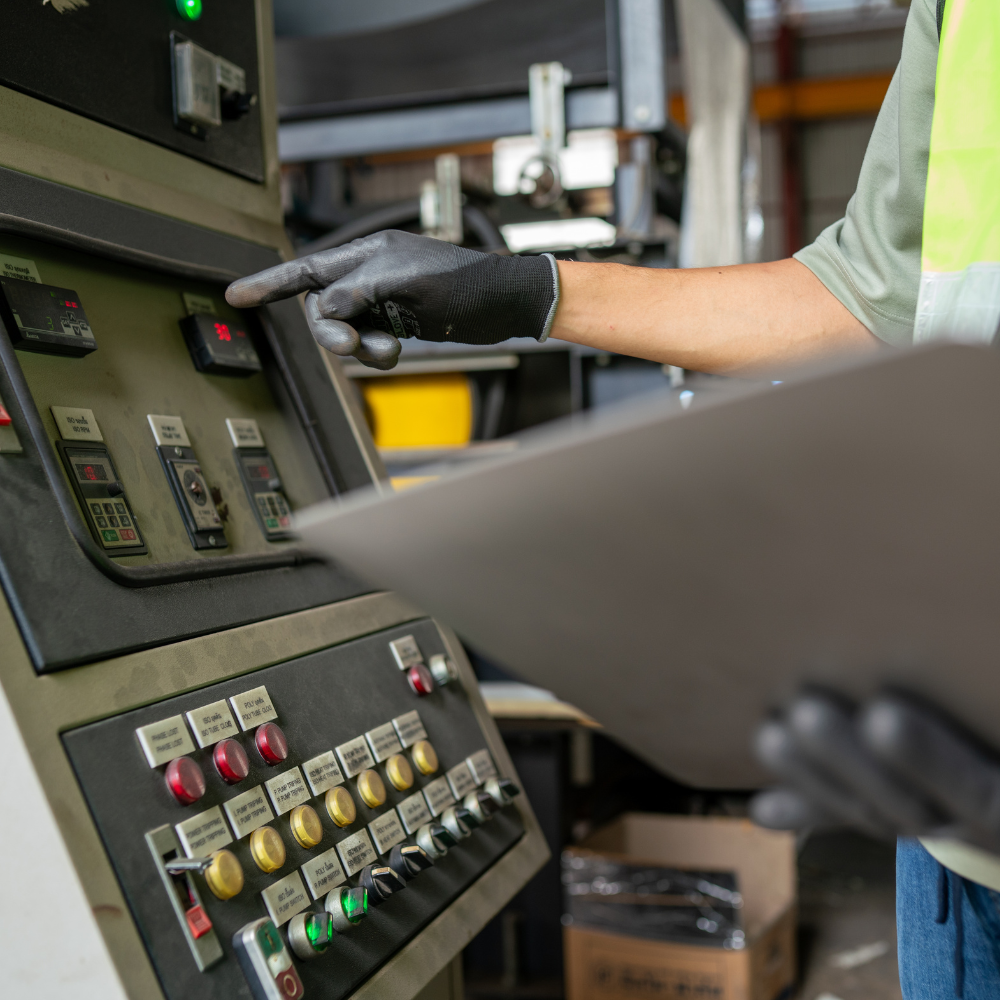
A properly configured recipe system removes the manual entry step entirely for validated products. Once a recipe has been created and confirmed to produce good product, loading it becomes a matter of selecting it from a list on the HMI — the same 40+ parameters get applied identically every single time, regardless of which shift or which operator is running the changeover.
The value of recipe-driven operation isn't abstract — it shows up in specific, measurable places on the production floor.
A significant share of scrap on many extrusion lines happens during startup and changeover, while the process is being dialed in manually. Because a recipe loads the process at settings already known to work, the line reaches on-spec production faster, cutting the volume of off-spec material generated during every changeover.
Wall thickness, diameter, and other dimensional properties are highly sensitive to temperature and speed consistency. When those parameters are loaded identically every time rather than approximated by hand, the resulting dimensional variation across batches — and across shifts — tightens considerably.
It's common for a particular product to run noticeably differently depending on which shift or which operator is running it, simply because of small differences in how each person sets up the process. Recipe-driven operation removes operator-to-operator variation as a factor entirely, since the same recipe produces the same settings regardless of who loads it.
Beyond the quality benefit, recipe systems also reduce the time changeovers take, since operators aren't manually working through a setup checklist. Faster changeovers mean more available production time and reduce the pressure that often leads to setup shortcuts in the first place.
Recipe management delivers on its promise only if the underlying recipes are built and maintained carefully — a poorly managed recipe system can just as easily standardize a bad process as a good one.
A recipe should only be saved and made available for general use after the process it represents has been validated — confirmed, through actual production runs and quality checks, to reliably produce good product. Saving a recipe from a single run that happened to work, without confirming repeatability, risks locking in a setup that isn't actually robust.
Not every operator should have the ability to create or modify a saved recipe. Restricting recipe creation and editing to process engineers or qualified personnel, while allowing operators to load and run existing recipes, preserves the integrity of the recipe library over time.
As products evolve or process improvements are identified, recipes need to be updated — but those updates should be tracked, not silently overwritten. A recipe system with version history makes it possible to trace a quality issue back to a specific recipe change, and to revert if a change turns out to cause problems.
The most effective recipe systems link directly to product or job identifiers, so operators select the product being run rather than hunting through a generic list of numbered recipes. This reduces the chance of loading the wrong recipe for a given job — a mistake that's easy to make when recipes are labeled ambiguously.
The consistency benefit of recipe-driven operation compounds further when paired with process data feedback — actual temperature, pressure, and speed readings captured during production and compared against the recipe's target values.
Even with a recipe loaded correctly, mechanical wear, ambient conditions, or material variation can cause actual process values to drift from the recipe's targets over the course of a run. Data feedback makes that drift visible in real time, rather than only showing up later as an out-of-spec quality result.
Over time, production data associated with each recipe run can reveal whether a recipe's target values are actually optimal, or whether small adjustments would improve yield or reduce cycle time — turning the recipe library into something that improves progressively rather than staying static.
For plants still relying on manual setup sheets, moving to recipe-driven operation doesn't necessarily require a full control system replacement — it depends on whether the existing PLC and HMI platform supports structured recipe storage and recall. For lines running on older relay-based or limited PLC systems, recipe management is typically one of the clearest, most immediately visible benefits of a broader control upgrade.
Not necessarily — it depends on whether the existing PLC and HMI platform supports recipe storage and recall. Lines on older or more limited control systems often need an upgrade to gain this capability.
Generally, recipe creation and editing should be restricted to process engineers or qualified personnel, while operators are given access to load and run existing, validated recipes without the ability to alter them.
By loading process settings already known to produce good product, a recipe system gets the line to on-spec production faster than manual setup, reducing the volume of off-spec material generated during every changeover.
A well-designed recipe system tracks version history for each recipe, so changes are documented and can be traced or reverted if needed, rather than silently overwriting the previous version.