
Discover how advanced control systems improve product consistency, reduce waste, and optimize your extrusion process. Explore our solutions or connect with our team to learn how ICT can modernize your production line.
Get Started TodayEvery plant manager knows the frustration of a control system failure where the fix is straightforward but the part isn't on the shelf — a line sitting idle not because the problem is hard to solve, but because the replacement component is a day or a week away. Building an effective spare parts strategy is one of the more overlooked levers for reducing extrusion line downtime, precisely because it doesn't require new equipment or capital investment, just a more deliberate approach to what gets stocked and why.
Spare parts inventory sits in an awkward space between operations and finance, which is part of why it often doesn't get the deliberate attention it deserves.
Spare parts inventory ties up capital sitting on a shelf, which makes it an easy target for cost reduction — but that framing misses that the real function of spare parts inventory is downtime reduction, which has its own significant financial value that doesn't show up on the same line item.
Without a deliberate strategy, spare parts decisions often happen reactively — a part fails, gets replaced, and then a replacement spare gets ordered afterward, rather than the plant having anticipated the need and stocked ahead of the failure.
In many plants, it's not entirely clear who owns the spare parts strategy — maintenance, purchasing, and plant engineering may each have partial visibility without anyone holding a complete, deliberate view of what should be stocked and why.
Rather than stocking everything or nothing, an effective spare parts strategy is built around a structured evaluation of criticality, failure risk, and lead time for each component category.
The starting point for any spare parts decision should be understanding the operational impact if the part fails and isn't immediately available — does it stop the entire line, degrade performance, or have a workaround? Parts whose failure stops production entirely deserve priority over parts with a lower operational impact.
Combining criticality with an honest assessment of failure likelihood — based on the plant's own failure history and the component's expected service life — helps avoid over-investing in spares for parts that rarely fail while under-investing in parts that fail more frequently than assumed.
A critical part with a one-day lead time from a local distributor represents much less risk than an equally critical part that requires weeks to source from an overseas manufacturer or a secondary market. Lead time should weigh heavily in the stocking decision, independent of the part's failure probability.
For most control system components, the carrying cost of stocking a spare is small relative to the cost of the downtime it prevents — but this comparison should still be made explicitly for higher-cost items, like a spare drive, rather than assumed.
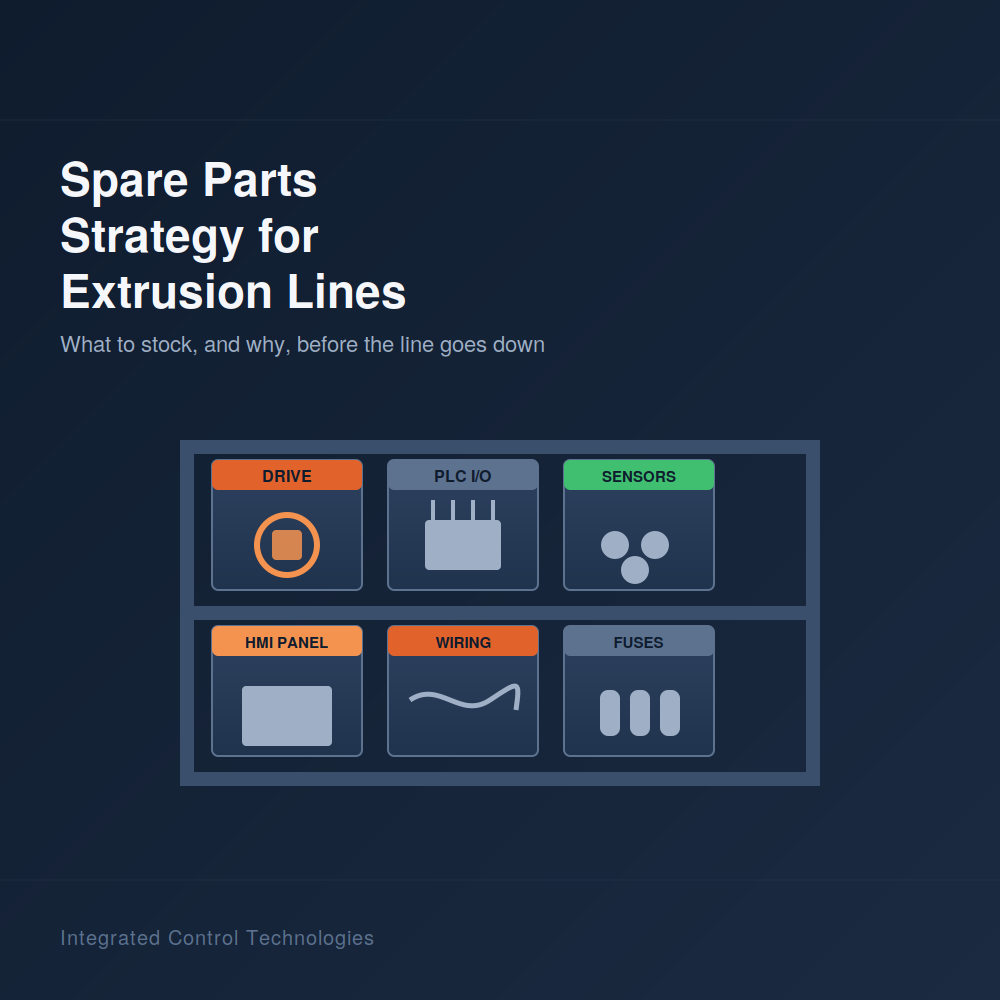
Different categories of extrusion control components warrant different stocking approaches, based on how they typically score against the framework above.
Drives are typically high-criticality, moderate-to-long lead time, and represent a significant individual cost — which usually justifies stocking at least one spare drive per critical line, particularly for older or less common drive models where lead time risk is elevated.
Individual PLC components tend to have shorter lead times than full drives if the platform is a current, actively supported model, but can become significantly higher risk if the platform has moved to legacy or discontinued status — worth reassessing stocking levels for older PLC platforms specifically.
HMI panels are typically lower failure-frequency components, but a failure directly prevents operator interaction with the line, making them high-criticality despite relatively low failure probability — a reasonable candidate for at least minimal spare stock.
Individual sensors — temperature probes, pressure transducers — are generally lower-cost, higher-failure-frequency components with typically short lead times from standard distributors, making them good candidates for maintaining a modest working stock rather than emergency-ordering each time one fails.
Basic electrical consumables are low-cost and high-frequency-use, and running out during a repair — even a planned one — creates unnecessary delay for a very low-cost item. These are worth keeping stocked simply as a matter of maintenance efficiency, independent of any formal criticality analysis.
Spare parts strategy becomes more complicated, and more important, for control systems running on older or discontinued platforms.
As a control platform moves toward discontinued or legacy status, the appropriate spare parts strategy shifts — lead time risk increases substantially, which often justifies increasing stock levels even for parts that historically had a low failure rate, simply because replacement becomes much harder if a failure does occur.
For platforms that are clearly heading toward obsolescence, proactively purchasing available spares from the secondary market while they're still reasonably accessible is often more economical than waiting until a failure forces an urgent, premium-priced search.
At a certain point, continuing to invest in spares for an aging platform becomes a less attractive option than planning a transition to modern controls — this is a useful checkpoint to revisit periodically rather than defaulting indefinitely to "just stock more spares."
A spare parts strategy is most effective when it's an ongoing process, not a one-time inventory purchase.
Periodically comparing what's stocked against what's actually failed and been used over the past year or two helps refine the strategy — removing excess stock for parts that rarely fail and adding stock for parts that have failed more often than anticipated.
Designating a specific person or role responsible for maintaining and periodically reviewing the spare parts strategy — rather than leaving it as everyone's shared, and therefore no one's specific, responsibility — significantly improves the consistency of the approach over time.
For organizations running multiple plants, standardizing control platforms across sites, where practical, allows spare parts to be shared or pooled between plants, reducing the total inventory needed to achieve the same level of downtime protection.
It depends on criticality and lead time, but for older or less common drive models supporting a critical line, stocking at least one spare per line is a common and reasonable practice, given the potential downtime cost of an extended sourcing delay.
Generally, spares investment should prioritize high-criticality, long-lead-time parts even if failure probability is lower, since the cost of stocking is usually small relative to the potential downtime cost if a rare failure does occur and no spare is available.
As a platform moves toward discontinued or legacy status, lead time risk for replacement parts typically increases significantly, which usually justifies increasing spares stock even for components that historically had a low failure rate.
Effective spare parts management generally requires a clearly assigned owner — often a maintenance or plant engineering role — rather than being left as a shared responsibility across multiple departments without anyone specifically accountable for it.