
Discover how advanced control systems improve product consistency, reduce waste, and optimize your extrusion process. Explore our solutions or connect with our team to learn how ICT can modernize your production line.
Get Started TodayExtruder control panels sit at the intersection of several standards that plant teams hear about constantly but rarely see laid out side by side. UL 508A governs how an industrial control panel is built and labeled, the National Electrical Code (NEC) sets installation requirements that include short-circuit current rating (SCCR) marking, and NFPA 79 defines the electrical requirements for the industrial machine itself. When a panel is replaced, upgraded, or modified in the field, each of these comes into play. Understanding what they require, and how inspectors and insurers interpret them, makes it easier to plan projects that pass inspection the first time and hold up over the life of the line.
UL 508A is the UL standard for industrial control panels, meaning assemblies of power circuit and control circuit components built into an enclosure to control industrial equipment. An extruder panel that houses the main disconnect, drive, heater contactors or SSRs, temperature controllers, a PLC, and an HMI is a typical example. The standard covers component selection, spacing, wiring methods, conductor sizing, overcurrent protection, enclosure type, and the markings the panel must carry.
A UL 508A label is not something a builder applies simply by following the standard. The label can only be applied by a shop that participates in UL's listing program for industrial control panels, which includes periodic follow-up inspections of the shop's work and procedures.
A panel built to UL 508A principles by a non-participating shop may be well constructed, but it is not a listed panel. That distinction matters when an inspector or insurer asks for evidence of listing rather than evidence of good practice.
Many jurisdictions and many corporate electrical policies expect industrial control panels to be listed or otherwise evaluated by a nationally recognized testing laboratory (NRTL). A listed panel gives the authority having jurisdiction (AHJ) a straightforward basis for approval.
SCCR is the maximum available fault current at which a panel or machine can safely operate when protected as specified. It is not the same as the interrupting rating of the main breaker. A panel's SCCR is generally limited by its weakest power circuit component or combination, which could be a drive, a contactor, a terminal block, a power distribution block, or a branch protective device.
The NEC requires industrial control panels to be marked with their SCCR, and it requires industrial machinery to carry a nameplate that includes the SCCR of the machine's electrical equipment. The NEC also requires that equipment not be installed where the available fault current exceeds its rating. In practice, the installer or engineer needs to know the available fault current at the point where the extruder panel connects to the plant distribution system and confirm the marked SCCR is equal to or greater than that value.
If the plant transformer is upsized or distribution changes, available fault current at the panel can change even though the panel has not.
Extrusion lines often draw substantial power for main drives and barrel heating, and they are frequently fed from larger transformers close to the line. That combination can produce high available fault current at the panel. A panel with an inadequate SCCR may not contain a fault safely, which creates arc flash and fire risk in addition to an inspection problem. Selecting drives, heater circuit components, and branch protection with adequate ratings, or using current-limiting fuses where appropriate, is part of designing the panel rather than an afterthought.
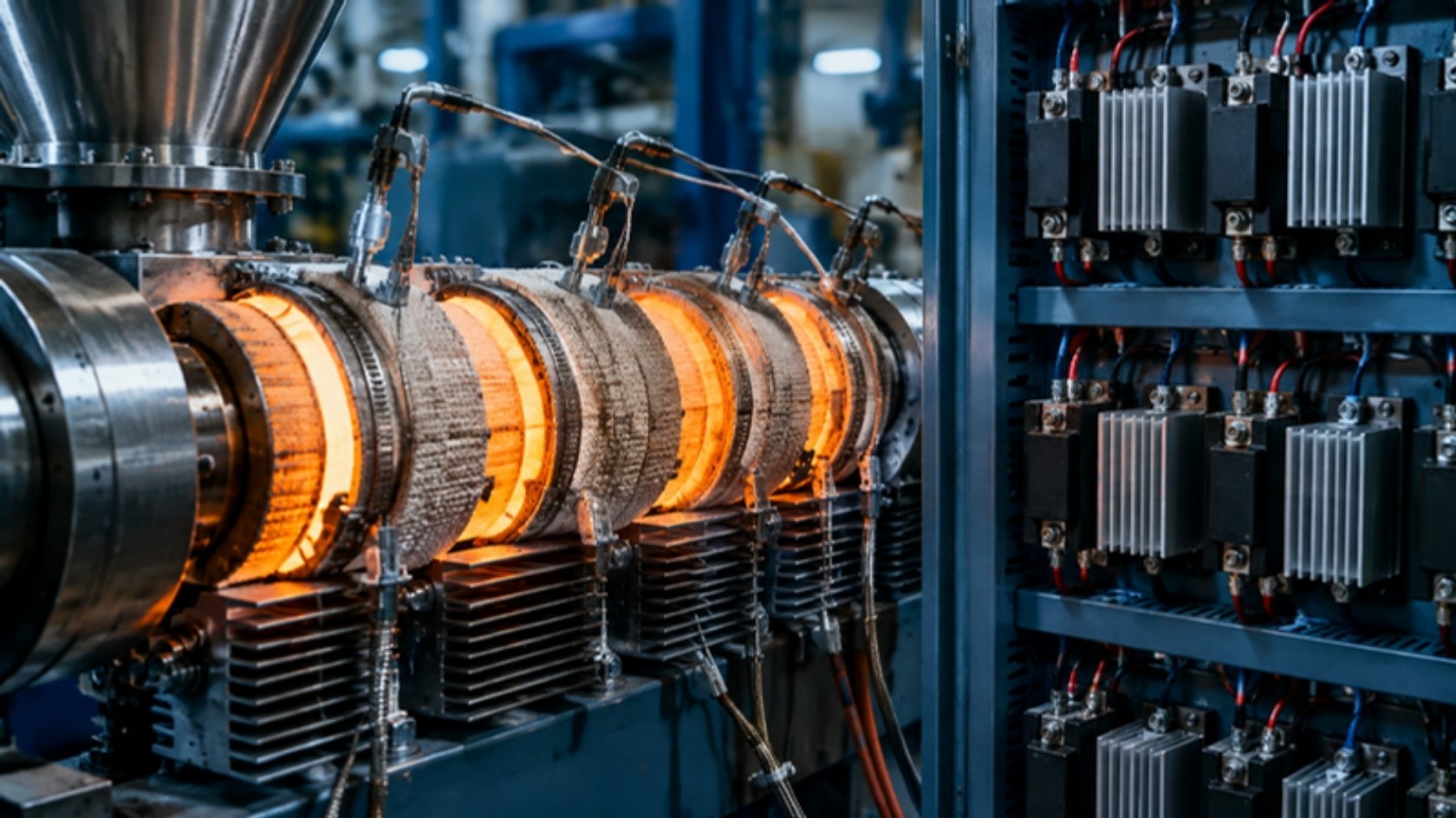
NFPA 79, the Electrical Standard for Industrial Machinery, applies to the electrical and electronic equipment of industrial machines, starting at the point of connection to the supply. The NEC covers the building wiring up to that point and references NFPA 79 for machinery. For an extruder, NFPA 79 addresses the machine's control panel, field wiring to heaters, thermocouples, motors, and sensors, operator controls, and safety functions.
NFPA 79 establishes conductor color conventions so that technicians can identify circuit types at a glance. In general terms, black is used for ungrounded AC and DC power conductors, red for ungrounded AC control circuits, blue for ungrounded DC control circuits, white or gray for grounded conductors, and green or green with yellow stripes for equipment grounding. Orange (or yellow) identifies circuits that remain energized from an external source when the main disconnect is off, such as interlock circuits shared with upstream or downstream equipment.
NFPA 79 requires a supply circuit disconnecting means for the machine that can be locked in the off position, which supports lockout and tagout. Circuits that remain live with the disconnect open need to be identified and their conductors marked accordingly.
Emergency stop devices are expected to have a red actuator on a yellow background where a background is used, to override other functions, and to require a deliberate reset. The standard defines stop categories, and an emergency stop must function as either an uncontrolled stop that removes power immediately or a controlled stop that brings the motion to rest and then removes power. For more on how these functions fit into broader machine safety expectations, see our post on safety interlocks in extrusion and what OSHA expects.
An AHJ that encounters an unlisted industrial control panel generally has a few options: accept it based on other evidence, require a field evaluation, or reject it. Many inspectors default to requiring a listing or field evaluation because they are not in a position to verify component ratings, spacing, and SCCR on site.
Property insurers and their loss control engineers often ask about electrical equipment during site surveys. Unlisted or heavily modified panels, missing SCCR markings, and missing documentation can show up as recommendations in survey reports, and expectations vary by carrier.
A UL 508A label applies to the panel as it was built and documented. Replacing a failed component with the same part, or an equivalent part permitted by the panel documentation, typically does not affect the listing. Adding circuits, changing a drive, swapping heater control components, changing wire sizes, or replacing protective devices with different types can affect the construction and the SCCR, and may mean the panel no longer matches its listing.
When that happens, the usual paths are to have a participating UL 508A shop evaluate and relabel the modified panel where the program allows it, to obtain a field evaluation, or to replace the panel. A DC-to-AC drive conversion is a common example, since it changes power components and often the SCCR.
Field evaluation is an inspection of a specific piece of equipment at its installed location by an evaluation body, often an NRTL, to determine whether it meets applicable requirements. NFPA publishes a recommended practice for field evaluation of unlabeled electrical equipment that many AHJs reference. It is commonly used for one-off machines, imported equipment, legacy panels, and panels that have been modified beyond their original listing.
The evaluator reviews construction, components, wiring, ratings, and markings, and may require corrections before applying a field label. Our extruder control installation timeline guide covers how to fit inspections into a changeover window.
Whether a panel is listed or field evaluated, documentation is what makes it supportable over time. A complete package typically includes electrical schematics, panel layout drawings, a bill of materials with manufacturer part numbers, the SCCR calculation and the components that determine it, nameplate data, wire numbering conventions, and the available fault current value used in the design.
Start by confirming what your AHJ and insurer expect, the available fault current at the line's point of connection, and whether existing panels will be reused, modified, or replaced. Ask any panel builder whether it participates in a UL 508A listing program, how it calculates and documents SCCR, and how it applies NFPA 79 requirements for colors, disconnecting means, and emergency stop.
Integrated Control Technologies designs and builds control systems for extrusion lines with these standards in mind, from the SCCR calculation and component selection to drawings and field wiring identification. If you are planning a new panel or upgrading an existing one, our extruder control systems page outlines how we approach these projects.
Requirements depend on the jurisdiction, the AHJ, and in some cases corporate or insurer policy. Many AHJs expect industrial control panels to be listed or field evaluated by an NRTL. This article is general information, not legal advice, so confirm requirements with your local AHJ and qualified professionals.
Replacing a part with the same component, or an equivalent allowed by the panel documentation, generally does not affect the listing. Changes in component type, rating, or circuit design may. When in doubt, consult the panel builder or an evaluation body before making the change.
The panel should not be installed or operated in that condition under the NEC. Options include redesigning the panel with higher-rated components or current-limiting protection, or reducing available fault current upstream. An engineering review is the right first step.
NFPA 79 is generally applied to new machinery and to modifications, and adoption depends on the jurisdiction and the edition in force. Legacy lines are often brought into closer alignment when panels or drives are replaced. Your AHJ determines how it is applied to a specific project.