Discover how advanced control systems improve product consistency, reduce waste, and optimize your extrusion process. Explore our solutions or connect with our team to learn how ICT can modernize your production line.
Get Started TodayMultilayer film extrusion is, in nearly every respect, a more demanding process than single-layer extrusion — more extruders to coordinate, more layers to keep in precise ratio, tighter tolerances driven by barrier and mechanical property requirements, and far more that can go subtly wrong without necessarily triggering an obvious fault. It's exactly the kind of process where the limitations of an aging control system stop being a background inconvenience and start becoming a direct constraint on what the line can actually produce.
Single-layer extrusion control, even on a fairly basic legacy system, can often produce acceptable product because there's less that needs to be coordinated simultaneously. Multilayer processes remove that margin for error.
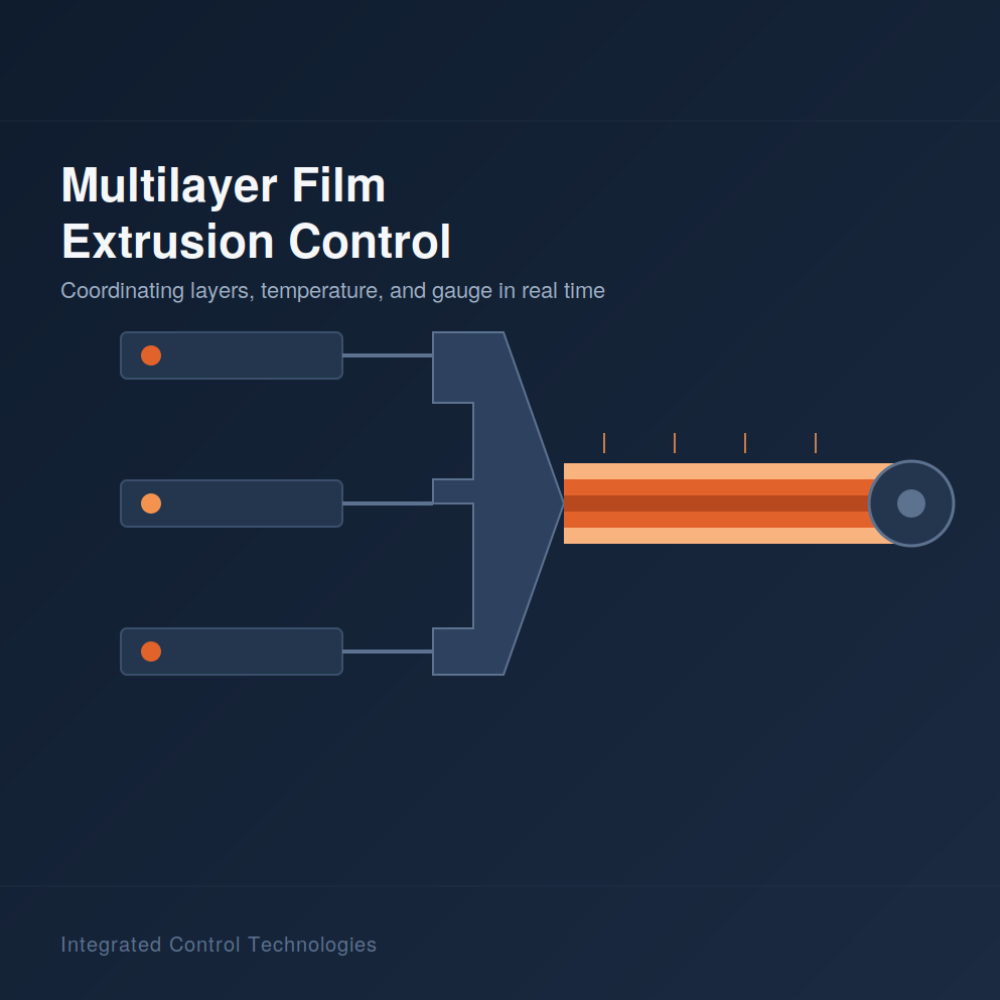
A multilayer blown film or cast film line typically has three, five, or more separate extruders, each feeding a different layer, all of which need to run in coordinated proportion to maintain the target layer ratio. Coordinating that many independent process loops is a fundamentally different control challenge than managing a single extruder.
Multilayer films are frequently built for specific barrier, seal, or mechanical performance requirements, which means individual layer thickness — not just total film thickness — needs to stay within a tight tolerance. Small variations that wouldn't matter in a single-layer product can compromise the functional performance of a multilayer structure.
With more extruders, more temperature zones, and more interdependent process variables, there are simply more things that can drift, fail, or interact in unexpected ways — which means the diagnostic and monitoring capability of the control system matters more, not less, than it does on a simpler line.
Several categories of control limitation show up especially clearly once a line moves from single-layer to multilayer production.
Older control systems, particularly relay-based or basic PLC platforms without layer ratio logic, often rely on operators manually balancing extruder speeds to hit a target layer ratio, checking it periodically through offline sampling. This approach is inherently reactive — the ratio can drift for an extended period between checks, with the first sign of trouble showing up as an out-of-spec sample rather than a real-time alert.
Multilayer lines often have a high total zone count across multiple extruders, dies, and adapters. Legacy systems with limited I/O capacity or basic on/off temperature control (rather than more precise PID-based control) struggle to maintain the tight, independent temperature regulation each zone needs, particularly when different layers use materials with different processing temperature requirements.
On a multilayer line, a change in one extruder's output can affect die pressure, which can affect film gauge uniformity across the web, which can affect winding tension. Legacy systems that present process variables in isolation, rather than in a way that shows these relationships, make it much harder for operators to diagnose why a quality issue is occurring when the root cause is several steps removed from where the symptom shows up.
Modern multilayer film production increasingly relies on automatic gauge profile control, where thickness measurements across the film web feed back automatically to adjust die bolts or extruder output. Legacy control platforms frequently can't integrate with this kind of closed-loop gauge feedback system at all, forcing plants to rely on manual die adjustments based on periodic operator measurements.
A multilayer product might involve a dozen or more interrelated parameters per layer — temperature profiles, speed ratios, and material-specific settings — across several extruders. Legacy systems without structured recipe management make it easy for small setup errors to creep in during changeovers, precisely because there are so many more parameters to set correctly than on a single-layer product.
The gap between legacy and modern control capability is where the case for an upgrade becomes most concrete for multilayer producers specifically.
Modern PLC-based systems can manage multiple extruders as a coordinated system rather than a set of independent units, maintaining target layer ratios automatically as conditions change, rather than requiring constant manual rebalancing.
More sophisticated temperature control algorithms, applied independently across a high zone count, keep each layer's processing temperature within a tighter band — directly supporting the tolerance requirements multilayer products typically demand.
Modern control platforms are generally built to integrate with automatic gauge profile systems, closing the loop between thickness measurement and die or extruder adjustment, which reduces reliance on manual operator intervention to maintain uniform film thickness.
A well-designed recipe system for a multilayer line stores every parameter for every extruder and layer as a single recipe, loaded together, removing the manual setup burden and the associated risk of error that comes with a high parameter count.
Modern HMI and data historian capability allows operators and engineers to view related process variables together over time — extruder speed, die pressure, gauge readings — making it far easier to identify how a change in one part of the process is affecting another.
For plants running multilayer lines on legacy controls, the upgrade case is often stronger and more measurable than it would be for a comparable single-layer line, simply because the process complexity makes the control limitations more visible in scrap rates, quality claims, and changeover time.
Tracking scrap and quality claims specifically attributable to layer ratio drift or gauge non-uniformity gives a concrete, quantifiable basis for evaluating whether improved control capability would pay for itself in reduced material waste.
If changeovers on multilayer products take noticeably longer than on single-layer products — often due to the number of parameters that need manual verification — that time cost is a direct, measurable symptom of a control system that isn't keeping pace with the process complexity it's being asked to manage.
They don't require fundamentally different technology, but they do require control systems capable of coordinating multiple extruders, managing high zone counts precisely, and often integrating with gauge feedback systems — capabilities that basic or legacy control platforms frequently lack.
Most legacy systems, particularly relay-based or basic PLC platforms, rely on manual operator adjustment to maintain layer ratio rather than automatic real-time coordination, which increases the risk of drift between checks.
Gauge profile feedback automatically adjusts die bolts or extruder output based on continuous thickness measurement across the film web, helping maintain uniform gauge. Legacy systems often can't integrate with this kind of closed-loop system, requiring manual adjustment instead.
The complexity of multilayer processes often makes control limitations show up more visibly — in scrap, quality claims, and changeover time — which can make the financial case for an upgrade clearer and more quantifiable than on a comparable single-layer line.