
Discover how advanced control systems improve product consistency, reduce waste, and optimize your extrusion process. Explore our solutions or connect with our team to learn how ICT can modernize your production line.
Get Started TodayRecycled and post-consumer resin (PCR) behave differently from virgin material, and the differences show up first in the control system. Melt flow shifts from lot to lot, moisture and volatiles arrive with the pellets or flake, and contamination loads screens faster than most lines were designed to handle. A line that ran virgin resin comfortably on fixed setpoints often needs tighter loops, better instrumentation, and real data logging to hold dimensions and quality with recycled content in the feed.
Virgin resin arrives with a narrow, documented property window. Recycled material carries the history of every product, wash line, and reprocessing step it has been through, and the extruder has to absorb that variation in real time.
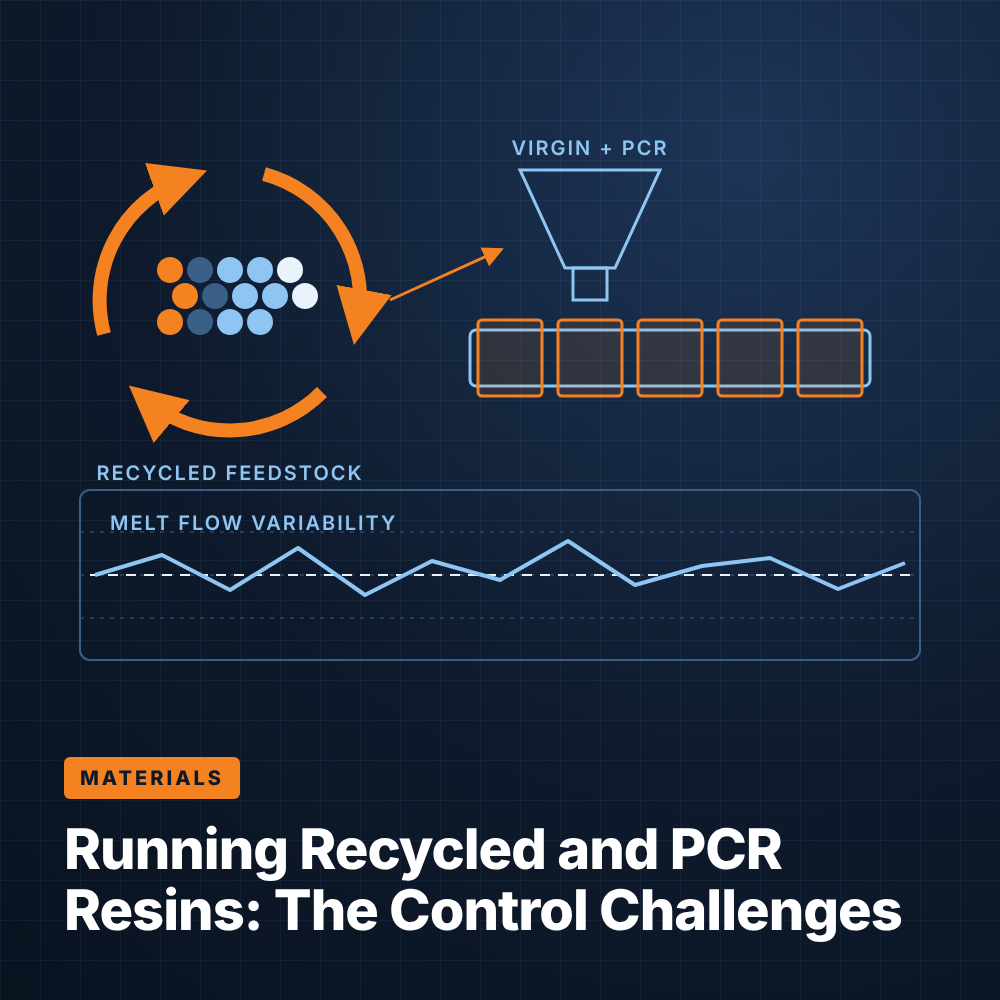
Melt flow index (MFI) on recycled material can move noticeably between lots and even within a single gaylord. Each heat history causes some chain scission or crosslinking depending on the polymer, and mixed-source streams blend grades that were never meant to share a hopper. The result is a feedstock whose viscosity is a moving target.
For the process, a change in viscosity means a change in melt pressure, motor load, and output per screw revolution at the same setpoints. On pipe or profile lines, that shows up as wall thickness drift; on film lines, as gauge variation. Operators who chase these shifts by hand tend to overcorrect, which adds a second layer of variation on top of the material itself.
Regrind and flake rarely have the uniform bulk density of virgin pellets. Because a volumetric feed delivers a fixed volume rather than a fixed mass, a change in bulk density becomes a change in throughput even when screw speed holds steady. Gravimetric feeding and loss-in-weight control address this directly by measuring mass rather than assuming it.
Two physical problems dominate recycled resin processing: what the material releases as it melts and what it carries that should not be there. Both put a load on equipment and controls that virgin material rarely does.
Washed flake and some recycled pellets hold surface and absorbed moisture, and hygroscopic polymers such as PET and nylon degrade quickly if processed wet. Hydrolysis lowers molecular weight, which in turn lowers viscosity and compounds the MFI problem described above. Dryer performance, dew point, and residence time need to be monitored and alarmed rather than assumed, and the dryer should be integrated with line interlocks so a dryer fault does not go unnoticed while production continues.
Residual inks, adhesives, labels, and absorbed moisture generate volatiles in the melt. Vented barrels and vacuum degassing zones remove them, but only if the vent stays open and the vacuum stays stable. Vent flooding happens when the screw section upstream of the vent delivers more melt than the downstream section can pump away, often triggered by a viscosity change. Monitoring vacuum level and melt pressure lets the control system flag developing flooding early.
Contamination in PCR, including paper fiber, aluminum, cross-polymer gels, and degraded material, loads screen packs far faster than virgin resin. As screens blind, pressure ahead of the changer rises, back-pressure on the screw increases, and output drops unless the drive responds. The pressure differential across the screen changer is the most useful single indicator of filter condition.
Continuous or automatic screen changers can be triggered on differential pressure, and a melt pump between the extruder and die decouples die output from upstream pressure swings. In that arrangement, the extruder speed is typically trimmed by a PID loop holding melt pump inlet pressure at setpoint, which keeps the pump properly fed as screens load and material viscosity shifts.
Most of the control changes needed for recycled resin are not exotic. They involve moving from open-loop operation toward closed-loop control on the variables that actually move when the material changes.
Recycled material often needs a different barrel profile than its virgin equivalent. Lower-viscosity lots may need cooler zones to maintain melt strength. Shear heating also changes with viscosity, so zones that ran near setpoint on virgin resin may run hot or cold on recycled blends.
Well-tuned PID loops with properly sized heating and cooling outputs keep each zone stable through these shifts. Melt temperature measurement at the die, not just barrel zone temperatures, gives a truer picture of what the material is experiencing. For a deeper look at zone tuning, see temperature control and consistency in extrusion.
Holding screw speed constant is the simplest control mode, but it passes material variation straight to the product. Pressure control, where screw speed adjusts to hold melt pressure, compensates for viscosity changes at the cost of some throughput variation. Mass-based control, using gravimetric feeders or line-speed trim from a downstream weight measurement, holds output per unit length. The right choice depends on the product, but recycled content generally rewards a closed-loop approach over fixed setpoints.
Screen loading and viscosity swings show up as changes in motor load. A modern vector drive holds screw speed tightly under changing load, and its torque reading becomes a usable process signal. Trending torque alongside melt pressure helps separate a material change from a mechanical problem.
Many processors blend recycled content with virgin resin to balance cost, properties, and sustainability targets. Accurate, documented blending turns a variable feedstock into a more predictable one.
Gravimetric blenders and multi-component loss-in-weight feeders meter each ingredient by mass and hold a set ratio as total throughput changes. The control system treats total rate as the master and each component as a ratio of it, so a change in line speed or extruder output scales every component together. Volumetric dosing, by contrast, lets the ratio drift whenever bulk density changes, which is common with regrind and flake.
Increasing the recycled percentage usually means adjusting temperature profile, screw speed, and downstream settings at the same time. Linking blend ratio to a recipe that also sets zone temperatures, pressure targets, and alarm limits lets operators move between formulations with a single, controlled change instead of a dozen manual edits.
Bringing each feeder's actual versus target rate into the line PLC and HMI lets the system alarm on ratio deviation and record what was actually fed, not just what was requested.
Customer and brand-owner demand for recycled content keeps growing, and so do requests to document it. The control system is the natural place to capture that record.
A recipe-driven control system stores setpoints for each product and blend, including temperature profile, screw speed or pressure targets, feeder ratios, and downstream settings. Variants for different recycled suppliers give operators a proven baseline. Access control on recipe edits keeps changes deliberate and recorded. The approach is covered further in recipe-driven extrusion for better batch consistency.
Proving recycled content and consistent quality requires a time-stamped record linking material lots to process conditions and finished product. Useful data points include the following:
With this data historized, quality teams can answer recycled content questions and tie defects to specific lots.
Plants considering higher recycled content should review whether their current controls can close the loops described above. Older relay-based systems, standalone temperature controllers, and analog DC drives often lack the integration needed for pressure control, ratio blending, recipes, and data logging. A practical evaluation looks at instrumentation, drive capability, PLC and HMI platform, and data infrastructure together. Integrated Control Technologies works with extrusion plants on this kind of assessment and upgrade through its extruder control systems, which consolidate drive, temperature, and process control on a single platform.
PCR viscosity varies from lot to lot because of different source products and heat histories, so the same screw speed produces different pressure. Screen loading from contamination also raises pressure over time. Closed-loop pressure control and a melt pump help absorb both effects.
It is not always required, but it is often beneficial. A melt pump isolates die output from upstream pressure variation caused by screen loading and viscosity shifts. For dimension-critical products such as pipe, profile, and film, it can noticeably stabilize output.
Gravimetric or loss-in-weight blending is preferred because it meters each component by mass and holds the ratio regardless of bulk density. Volumetric dosing allows the ratio to drift as regrind and flake density change. Linking the blend ratio to recipes keeps related process settings aligned.
At a minimum, log resin lot numbers, actual blend ratios, key temperatures and pressures, screw speed, and line speed, all time-stamped. Alarms and recipe changes should be recorded as well. This lets quality teams tie finished product back to specific material and process conditions.